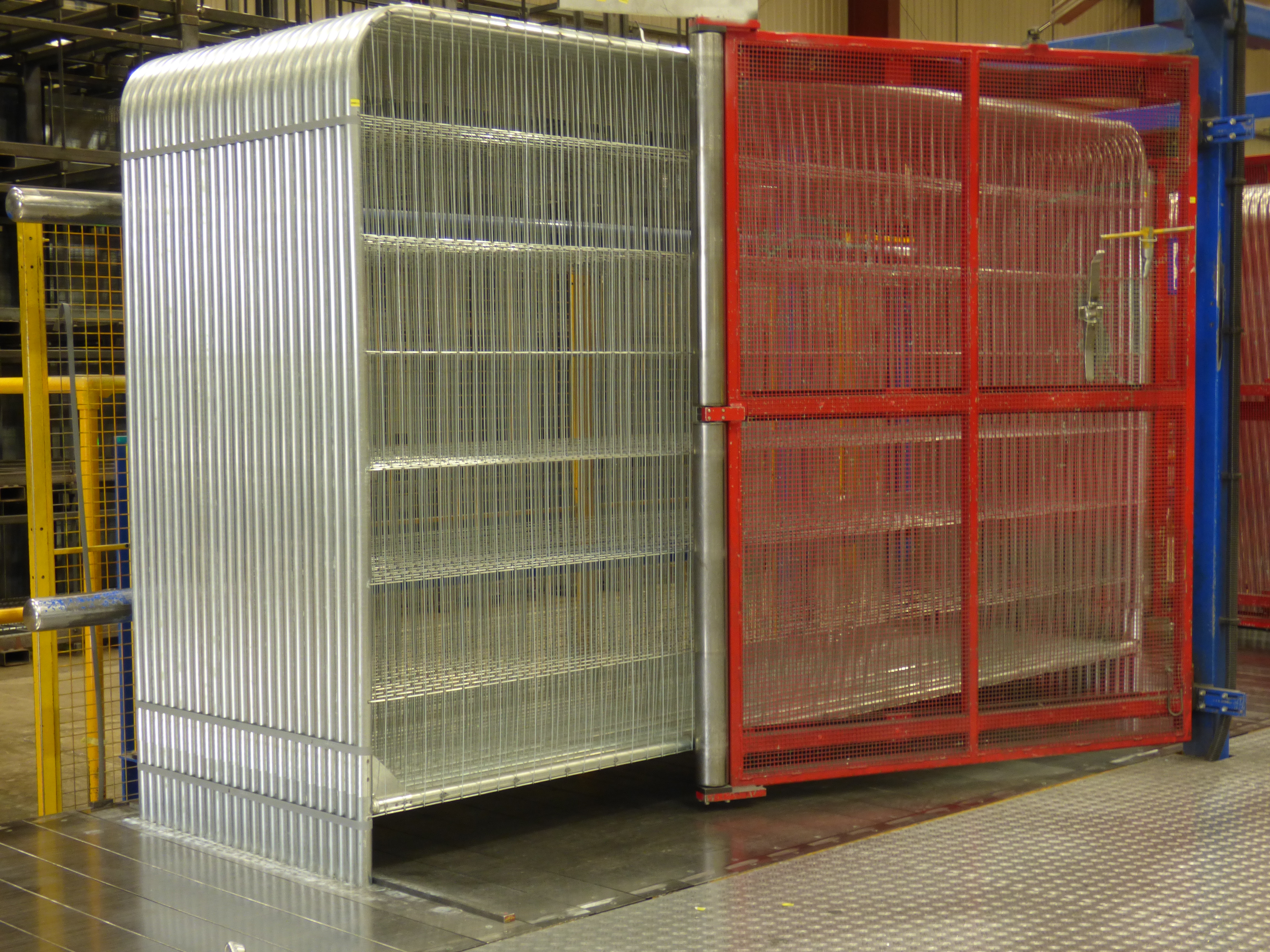
Featured photograph: temporary welded fence panels in a factory, photographed by MykelH. Source: Wikimedia Commons, licensed CC BY-SA 4.0. The original file is reproduced without alteration and scaled for display. It is a reference manufacturing scene, not a Wire Mesh Selector supplier or customer project.
Two fence quotations can both say “2.0 × 2.5 m welded panel, 50 × 200 mm mesh, 5 mm wire” and still describe different products. One supplier may mean centre-to-centre pitch while another means clear opening. A polymer-coated panel may quote the steel-core diameter or the finished outside diameter. The frame, bends, edge wires, clips and posts may be inside one price and absent from the other.
This guide turns that short description into a checkable request for quotation. It also shows how to use the Wire Mesh Weight Calculator to estimate the mass of the rectangular welded grid. The estimate is a geometry and logistics check—not proof of coating mass, weld strength, fence security, installed wind capacity or compliance.
1. Define mesh as pitch, not an unexplained “opening”
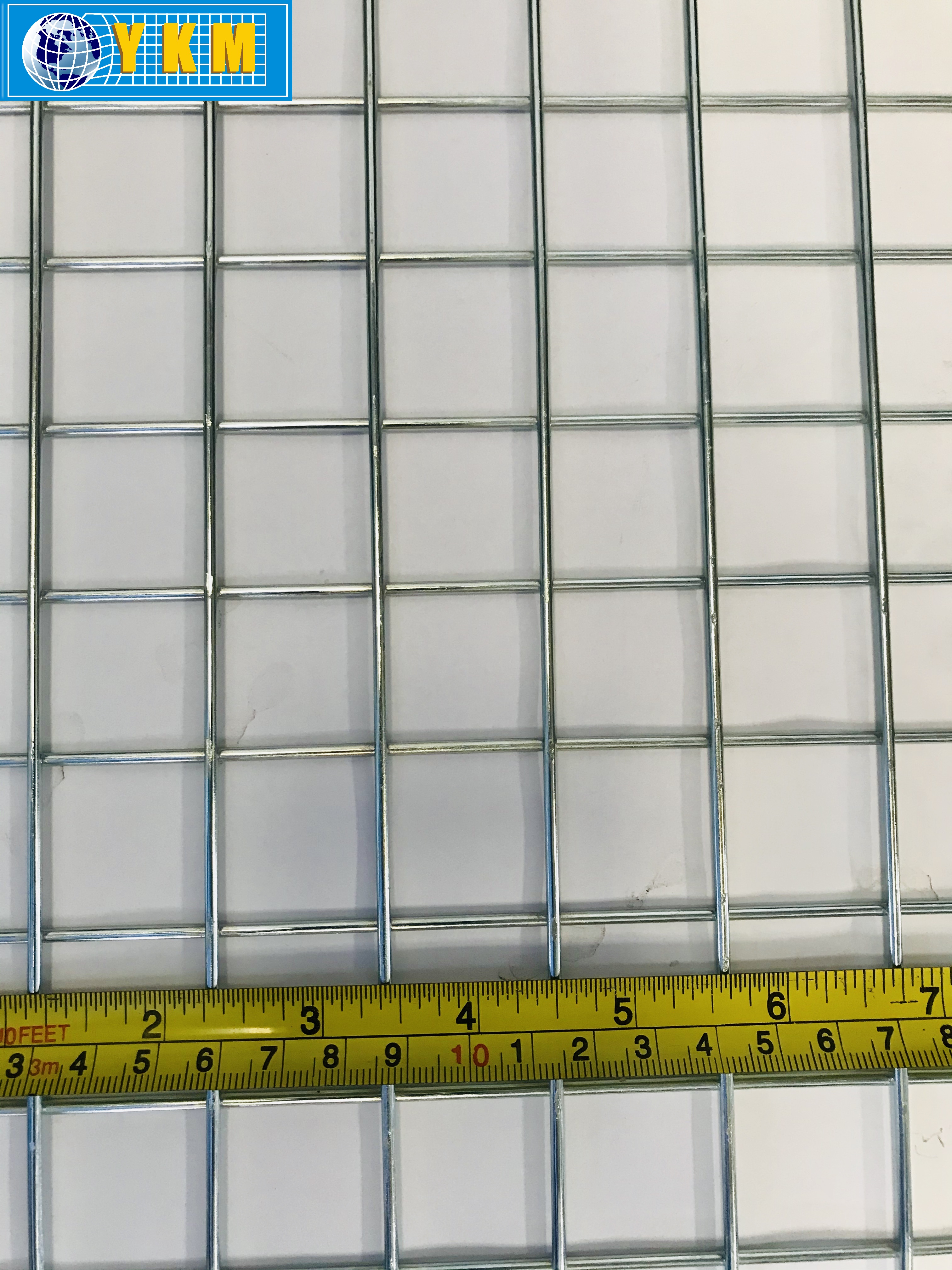
For an orthogonal welded grid, pitch is the distance from the centre of one parallel wire to the centre of the next. Clear opening is the unobstructed gap between wire surfaces. For nominal round wires:
clear opening X = pitch X − projected wire diameter X
clear opening Y = pitch Y − projected wire diameter Y
A 50 × 200 mm pitch with 5.0 mm projected wires therefore has nominal clear openings of 45 × 195 mm. If a quotation instead treats 50 × 200 mm as clear opening, the corresponding pitches become 55 × 205 mm. These grids do not have the same number of wires across a panel, theoretical mass or edge layout.
Place a dimensioned panel drawing in the RFQ. Label the direction of the closely spaced wires, the two centre-to-centre pitches, panel height and width, edge overhangs, bends or corrugations, and the relationship between mesh and frame. Our clear opening versus pitch guide explains the measurement distinction in more detail.
2. Work a 50 × 200 mm panel example in the weight tool
Consider a hypothetical flat, unframed carbon-steel grid with 50 mm pitch in X, 200 mm pitch in Y, 5.0 mm steel wires in both directions, and finished dimensions of 2.0 × 2.5 m. The nominal grid area is 5.0 m².
The calculator models the length of wire per square metre in each direction, multiplies it by the round-wire cross-sectional area and density, then adds the two directions:
mass/m² = (1000 ÷ pitch X) × area(wire X) × density + (1000 ÷ pitch Y) × area(wire Y) × density
Using 7,850 kg/m³ for carbon steel and a 5.0 mm diameter, the theoretical result is approximately 3.854 kg/m². For 5.0 m², the result is approximately 19.27 kg per panel. An order of 100 hypothetical panels therefore gives 1,926.8 kg of grid steel before the exclusions discussed below.
| Input | Value | Meaning |
|---|---|---|
| Construction | Welded rectangular grid | Not woven cloth or chain link |
| Pitch X / wire X | 50 mm / 5 mm | 45 mm nominal clear gap |
| Pitch Y / wire Y | 200 mm / 5 mm | 195 mm nominal clear gap |
| Panel width / length | 2.0 m / 2.5 m | 5.0 m² nominal grid area |
| Calculated grid mass | 19.27 kg/panel | Geometry estimate only |
Reproduce the calculation
- Open the Wire Mesh Weight Calculator.
- Select “Welded rectangular grid” and “Mild steel.”
- Enter 50 mm pitch and 5 mm wire for X; enter 200 mm pitch and 5 mm wire for Y.
- Enter 2.0 m finished width, 2.5 m finished length and the required panel quantity.
- Confirm the nominal clear opening is 45 × 195 mm and the estimated panel mass is about 19.27 kg.
The model treats the grid as straight, continuous, round steel wires at the stated pitches. It excludes polymer density, metallic coating mass, edge-wire count effects, cut ends, bends, frames, posts, feet, clips, fasteners, packaging and manufacturing tolerances. Use an approved sample, drawing and measured shipment data for final acceptance or freight planning.
3. Do not enter finished coated diameter as steel-core diameter
A caliper placed over a polymer-coated wire measures the finished outside diameter, not automatically the diameter of the steel core. The distinction matters because round-wire steel area changes with diameter squared.
If the example panel has a 5.0 mm steel core but a 5.5 mm finished diameter, entering 5.5 mm as solid carbon steel produces an estimated 4.662 kg/m² and 23.31 kg per panel. That is about 21% above the 5.0 mm-core grid estimate. The difference is not the actual coating mass; it is the error created by pretending the entire 5.5 mm circle is steel.
Ask the quotation to state separately:
- nominal steel-core diameter for each wire direction;
- finished outside diameter or coating-thickness requirement, where applicable;
- coating material and process, including whether coating is applied before or after welding;
- test method, sampling and documents used to support the stated coating requirement.
“5 mm PVC wire” is not enough. It can be interpreted as a 5 mm finished diameter or a 5 mm core plus coating, leading to different mass and geometry. Likewise, wire gauge alone is risky because gauge systems and rounding conventions vary. Use millimetres or inches and state whether the value is nominal core or finished diameter. See our wire gauge versus diameter RFQ guide.
4. Match the cited fence standard to the offered fabric
A standards reference should identify the correct scope and edition. According to ASTM’s current product pages, ASTM F2453/F2453M-14(2025) covers metallic- or polymer-coated welded wire mesh fence fabric with uniform meshes of 6 in² (3,871 mm²) or less, supplied in panels or rolls. ASTM F2919/F2919M-12(2025) covers panels with variable mesh patterns or meshes greater than that area threshold.
A nominal 50 × 200 mm pitch has a pitch-cell area of 10,000 mm², so a buyer should not cite the small-uniform-mesh scope merely because the 50 mm dimension looks small. Confirm how the governing document defines mesh area and product classification rather than selecting a standard from a keyword match. If the project uses another regional or owner specification, that contract requirement takes priority.
These product standards do not turn a mesh panel into a complete installed fence design. Posts, foundations, attachment details, gates, terrain, wind exposure and the required security function need project-specific treatment. ASTM also lists F3204-16(2024) as a guide for welded wire fence systems for security purposes. Applicability must be determined by the project specifier; a supplier should not promise a security class from panel mass alone.
5. Edge layout can change fit even when pitch is correct
Nominal panel width divided by pitch does not always produce an integer number of spaces. Edge overhangs, framed borders and where the first and last wires sit determine the finished dimension. A buyer who checks only one interior pitch can still receive a panel that does not align with clips, posts or an adjacent module.
The approved drawing should show:
- finished overall width and height with tolerances;
- number of wires or spaces in each direction;
- first- and last-wire locations or edge overhang dimensions;
- orientation and dimensions of bends, ribs or corrugations;
- frame or tube dimensions, weld locations and drainage details where relevant;
- clip or bracket centres and required installation clearance.
For a repeat order, measure a known acceptable panel using the approach in How to Measure a Wire Mesh Sample. Record multiple pitches across a longer span instead of relying on a single opening. Photograph the measurement setup, but retain the actual readings and instrument information.
6. Compare a complete fence bay, not just kilograms of mesh
A lighter quotation is not necessarily an underweight panel, and a heavier quotation is not necessarily better. The theoretical grid estimate is most useful as a consistency check. Compare it with the supplier’s stated panel mass and ask for an explanation of material that the model excludes.
For each fence bay, identify the panel, posts, rails if used, clips, bolts, caps, base plates or feet, ground anchors, gates and spare parts. State whether panel price includes the frame and whether quoted shipping mass includes pallets. For temporary fencing, define the base and coupler system; for permanent fencing, provide the approved foundation and post details. Do not use a mesh calculator to size foundations.
Request a preproduction sample or first-article inspection when fit, coating appearance or connection compatibility is important. Agree how diameter, pitch, overall dimensions, weld condition and coating damage will be sampled. A certificate should trace to the supplied batch and cite the specified requirement; a generic catalogue sheet is not batch evidence.
Copy-ready welded fence panel RFQ checklist
- Application, site environment and governing project specification.
- Quantity, panel drawing number and revision.
- Overall panel width and height, tolerances and measurement condition.
- Pitch X and pitch Y, wire orientation, edge layout and number of wires/spaces.
- Steel-core diameter by direction; finished coated diameter or coating thickness separately.
- Steel and coating system, process sequence, colour where relevant, and required documentation.
- Flat, bent or framed construction; frame section and weld details.
- Posts, bases, rails, clips, fasteners, gates and spares included or excluded.
- Nominal panel mass, shipping mass, packaging and pallet limits.
- Inspection plan, test reports, sample approval and treatment of deviations.
If a supplier offers a different pitch, wire, coating or edge arrangement, require a marked deviation list. Do not allow the quotation title “equivalent welded mesh” to replace a line-by-line comparison. For help converting a drawing or sample into a structured request, request a mesh specification recommendation.
Frequently asked questions
Can panel weight confirm wire diameter?
It can flag an inconsistency, but it cannot uniquely prove diameter. Frames, coatings, pitch, edge counts, tolerances and attached hardware also affect measured mass. Verify diameter and geometry directly using the agreed sampling method.
Should the calculator use pitch or clear opening?
For welded rectangular grids, enter centre-to-centre pitch. The tool then reports nominal clear opening by subtracting the corresponding wire diameter.
Does the calculated 19.27 kg include the fence frame?
No. It is the hypothetical unframed grid estimate for the stated geometry. Frames, bends, clips, posts, bases, coatings and packaging are excluded or only approximated.
Is “galvanized and powder coated” a complete coating specification?
No. It names processes but not necessarily required materials, thickness or mass, sequence, preparation, test methods, acceptance limits or repair rules. State the governing requirement and requested evidence.