A replacement quote that looks complete—but is not
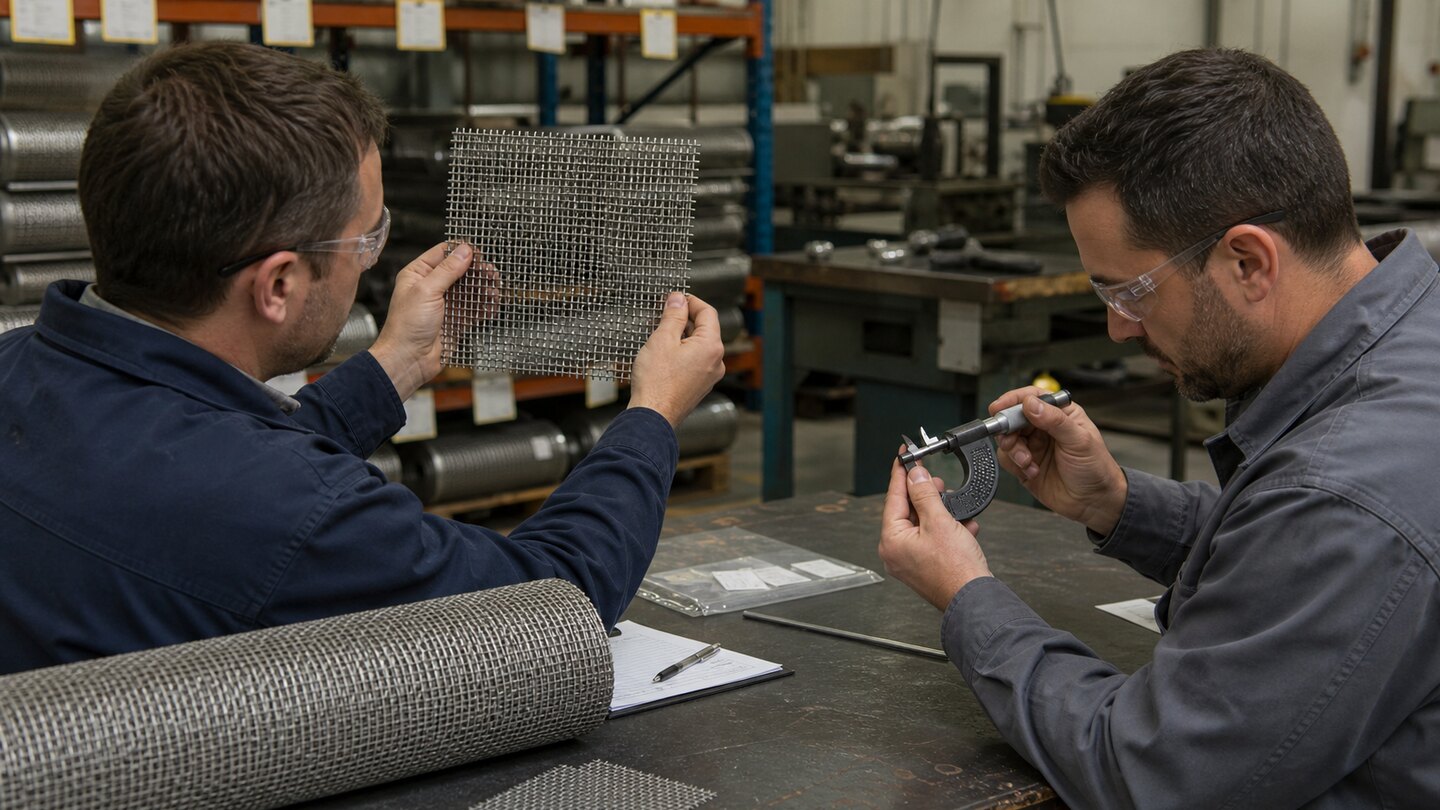
A maintenance buyer needs a replacement stainless screen for a wash-water strainer. The old purchasing note says “10 mesh SS304, 24 gauge.” One quotation repeats that wording. Another supplier quotes 10 mesh × 0.56 mm wire. Both prices look plausible, but the buyer cannot yet tell whether the constructions are equivalent.
The problem is the word gauge. It is a label from a particular gauge system, not a complete wire-mesh dimension. “24 gauge” is not a safe calculator input until the gauge system is identified and the supplier confirms the nominal wire diameter in millimetres. Even then, a wire diameter alone does not state mesh count, clear opening, material grade, weave, tolerance, edge condition or inspection method.
This guide shows how to turn gauge shorthand into a specification a supplier can check. It uses two explicitly confirmed wire diameters at 10 mesh to expose the geometric and commercial difference, then provides a practical RFQ checklist. Use the Woven Wire Mesh Calculator for the arithmetic, but keep the final purchase description in dimensions and requirements—not in an unexplained gauge number.
Gauge is a naming system; wire diameter is a dimension
Gauge
A gauge number is meaningful only together with the named system or table. Different systems exist, and a gauge reference is not itself a contract tolerance or a mesh construction.
Nominal wire diameter
A value such as 0.560 mm is a dimension that can be used in square-mesh geometry and verified against an agreed tolerance.
Mesh count
For ordinary square-opening woven cloth, mesh count is the nominal number of openings per linear inch in each principal direction.
Complete construction
Opening, wire, material, weave, dimensions, edges, tolerances and inspection complete the purchasing description.
Do not silently convert an unspecified gauge to millimetres. Ask the person who created the record or quotation: Which gauge system is intended? What is the nominal wire diameter in mm? What delivered wire tolerance applies? A supplier should be able to put the metric wire size and relevant tolerance on the drawing, data sheet or quotation. If those answers are unavailable, treat the old gauge note as a lead for sample measurement—not as an orderable specification.
ASTM B258 is an American Wire Gauge standard for solid round electrical conductors. It is useful evidence that an AWG label is tied to a defined table and application context; it is not, by itself, an industrial woven-wire-cloth acceptance specification. For industrial woven cloth, ISO’s ISO 4783-2 abstract gives a more useful designation sequence: aperture width, wire diameter, wire material and weave type. The contract must still name the governing standard and all applicable requirements.
The geometry that a confirmed diameter unlocks
For a regular square-opening woven cloth with nominal mesh count n and round wire diameter d, one inch is 25.4 mm. The nominal pitch is 25.4 divided by n. One pitch contains a clear opening plus one wire diameter. These equations describe ideal projected geometry; they do not establish delivered aperture tolerance, filtration performance, pressure loss or service life.
pitch (mm) = 25.4 ÷ mesh count
nominal opening (mm) = pitch − wire diameter
geometric open area (%) = (opening ÷ pitch)² × 100
The calculator also returns a nominal mass estimate. It treats the construction as straight wire at the selected material reference density. Crimp, weave, tolerance, edge treatment, dirt, frames, packaging and supplied dimensions can change delivered mass. Use it to compare likely material and freight differences, then request the supplier’s actual weight and tolerance for the offered construction.
Worked comparison: same 10 mesh, two confirmed wire diameters
To show why this matters, assume the mesh count really is 10 openings per inch and the material reference is stainless steel 304. The first supplier confirms 0.50 mm nominal wire. The second confirms 0.56 mm nominal wire. These are deliberately stated as millimetre values; the comparison does not assume that either value is “24 gauge” in an unnamed table.
| Calculated value | 10 mesh × 0.50 mm | 10 mesh × 0.56 mm | Why it matters |
|---|---|---|---|
| Pitch | 2.540 mm | 2.540 mm | Fixed by the same mesh count |
| Nominal clear opening | 2.040 mm (2,040 µm) | 1.980 mm (1,980 µm) | 60 µm smaller with the heavier wire |
| Geometric open area | 64.50% | 60.77% | About 5.80% lower relative to the first construction |
| Nominal SS304 mass* | 1.226 kg/m² | 1.538 kg/m² | About 25.44% higher in the straight-wire model |
| 1 m × 30 m roll estimate* | 36.78 kg | 46.14 kg | About 9.36 kg difference before packaging and tolerance |
*Calculated with this site’s woven-mesh mass model and its SS304 reference density of 7,930 kg/m³. It is a comparison estimate, not a certified roll weight or delivery condition.
Both quotations can truthfully say “10 mesh,” yet they do not describe the same nominal opening or metal content. A 60 µm difference may be important for a critical screen, while the material difference can affect price, handling and freight. This is why an RFQ that repeats only mesh count and gauge may create a false price comparison.
What to ask when a quote says “24 gauge wire mesh”
- Name the gauge system. Ask whether the quotation refers to AWG, SWG, BWG or another expressly identified table. Do not infer it from the supplier’s location or from a previous order.
- Request the nominal wire diameter in mm. Put it in the quotation and purchase order. This is the value to enter into geometry and weight tools.
- State the tolerance and inspection basis. A nominal value without an agreed tolerance or method does not define acceptance. Confirm whether the relevant tolerance is for the incoming wire, woven cloth or a finished fabricated screen.
- Separate material from size. “Stainless” does not establish a wire diameter, and a gauge label does not establish alloy grade. State the required grade and material specification independently.
- Confirm the construction. State square-opening woven cloth, the weave type, mesh count, nominal opening, roll or panel size, edge condition, support or frame where applicable.
Measure a sample without creating a false reading
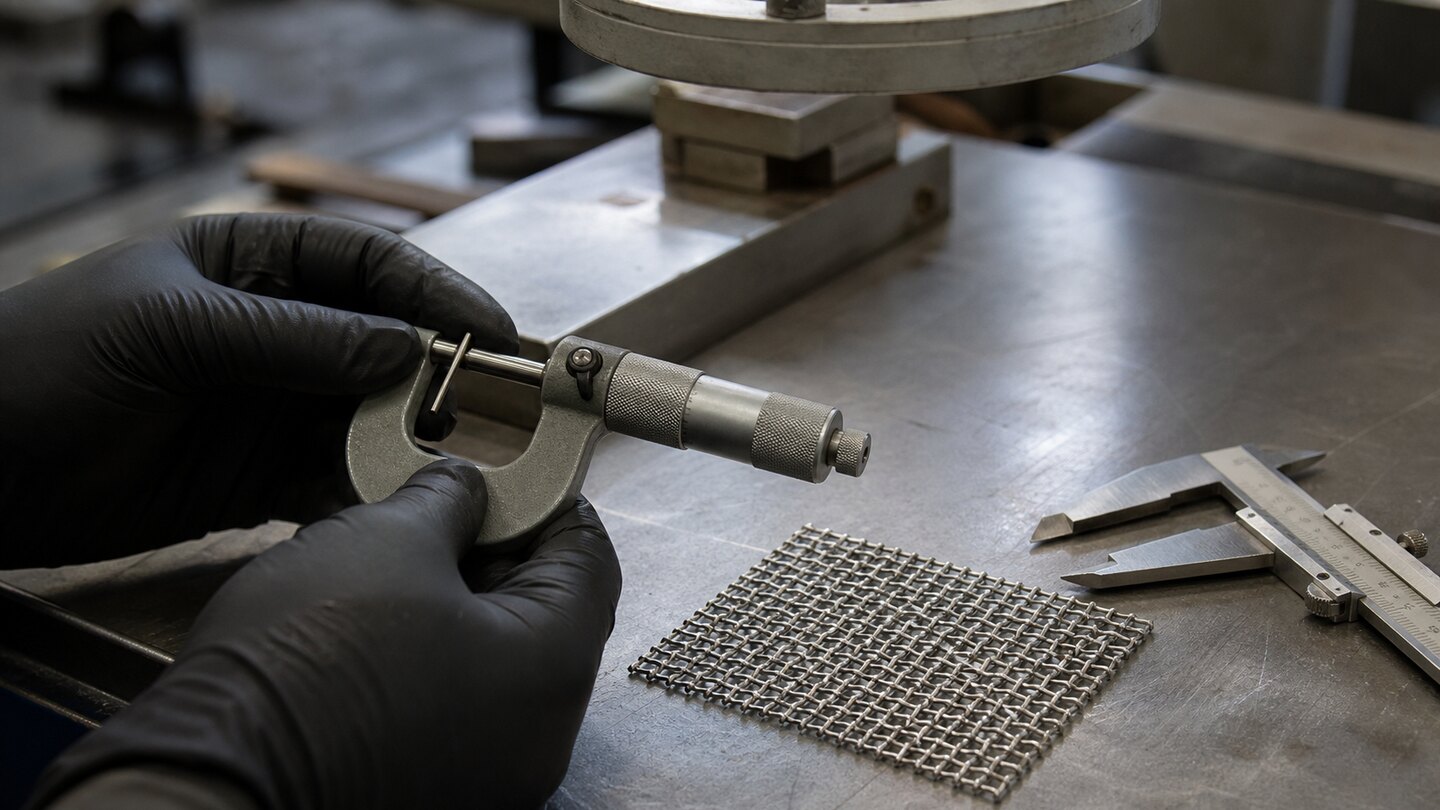
When the historical gauge cannot be resolved, obtain a representative sample or retained offcut. Record the machine location, product handled, direction of flow, screen/frame dimensions, supplier marks, installation details and failure mode before cutting or cleaning it. Use the approved isolation and contamination-control procedure for the process.
- Identify the construction first. This guide’s equations apply to regular square-opening woven cloth. Dutch weave, welded mesh, pre-crimped screen, perforated plate and expanded metal need their own terminology and inspection approach.
- Use suitable calibrated equipment. An outside micrometer can measure a clean, straight round wire sample. For fine woven cloth, a suitable optical method may be more practical. Do not squeeze, flatten or measure over a crossover.
- Take multiple readings. Record positions, directions and individual values. Do not hide a visibly worn, corroded or damaged area by reporting one convenient number.
- Measure opening and count separately. Use magnification and a useful calibrated distance. A count and a diameter can be combined to calculate nominal opening, then checked against direct aperture observations.
- Distinguish service wear from original construction. Abrasion, stretching, corrosion and cleaning can alter a retained screen. A sample is evidence, not automatically the original factory specification.
For a practical measurement checklist, see How to Measure a Wire Mesh Sample. Where dimensions are acceptance-critical, agree the governing standard, sampling plan, measuring equipment and reporting format with the supplier before ordering.
How to compare the two quotations fairly
Start with the actual proposed geometry, not the original shorthand. Enter each supplier’s mesh count and confirmed wire diameter in the Woven Wire Mesh Calculator. Record the resulting nominal opening, open area and modelled mass in the comparison sheet. Use the Mesh & Micron Converter to present the clear opening in the unit used by process, quality or filtration teams. Use the Wire Mesh Weight Calculator to compare finished quantities, but do not substitute the result for a supplier commitment.
Then compare like for like: material grade and condition; weave; opening and wire tolerances; roll/panel dimensions; cut or selvage edges; flatness and frame condition; inspection report; certification; packaging; lead time; and Incoterms. The wire mesh quotation comparison guide provides a supplier-neutral framework. A lower price is not a lower-cost choice if it is calculated from a smaller opening, different alloy, lower documentation level or an unstated tolerance.
Standards help define the question, not eliminate engineering judgement
ASTM E2016-22 covers industrial woven wire cloth for general use within its stated scope, including wire tolerances and delivery terms, while excluding several special constructions. ISO 4783-2 provides preferred combinations and a designation convention for woven wire cloth within its scope. Read the current full document named by the purchase contract; web summaries cannot replace its definitions, tolerances, sampling rules or exclusions.
Neither a standard title nor a calculator result proves suitability for an installation. Screen duty can depend on differential pressure, vibration, abrasive wear, temperature, chemistry, cleaning, span, backing support, blinding, particle shape and acceptable carryover. When process performance matters, require a representative sample, trial or acceptance test. The calculated open area is geometric projected porosity, not a flow-rate or separation-efficiency guarantee.
RFQ wording that a supplier can verify
Replace the ambiguous line “10 mesh, 24 gauge stainless” with a statement that exposes the variables. The following is an illustrative structure; fill in the project’s actual requirements and applicable standard rather than copying the values blindly:
Industrial square-opening woven wire cloth for [application];
mesh count: 10 openings per linear inch; nominal wire diameter: 0.560 mm;
calculated nominal opening: 1.980 mm; material: SS304 [state material requirement];
weave: plain [or state]; finished size, edges/frame and support: [state];
wire and aperture tolerances, inspection and documentation: [state governing requirements];
supplier to confirm offered nominal values, tolerance basis, actual roll/panel mass and availability.
For a re-order based on a used screen, include photos, dimensions, measured readings, process duty, operating temperature, product or fluid, cleaning method, support arrangement, quantity and acceptable delivery dates. If the material selection is still open, use the Wire Mesh Material Selector to structure exposure questions, then obtain application-specific compatibility advice. If the old record remains incomplete, use Request a Recommendation with the sample evidence rather than letting a supplier’s first quote become the specification by default.
Frequently asked questions
Can I enter “24 gauge” directly into the Woven Wire Mesh Calculator?
No. First identify the gauge system and confirm the intended nominal wire diameter in millimetres. Enter the confirmed mm value, mesh count and material reference; then document the tolerance separately in the RFQ.
Does the same mesh count always mean the same opening?
No. At a fixed mesh count, a thicker wire leaves a smaller nominal opening and lower geometric open area. The 10-mesh worked example above shows the change between 0.50 mm and 0.56 mm wire.
Does a material grade determine the gauge conversion?
No. Material and wire-size designation are separate fields. State the alloy or material requirement, the nominal wire diameter in mm, and the applicable tolerance independently.
Is the calculator’s mass value the shipment weight?
No. It is a straight-wire estimate using a material reference density. Confirm supplied mass, dimensions, crimp, edges, frames, packaging and tolerance with the supplier.
Can this method specify Dutch weave or welded mesh?
Not directly. The square-opening equations are for regular woven cloth. Dutch weave, welded mesh and other constructions need construction-specific dimensions, standards and performance review.