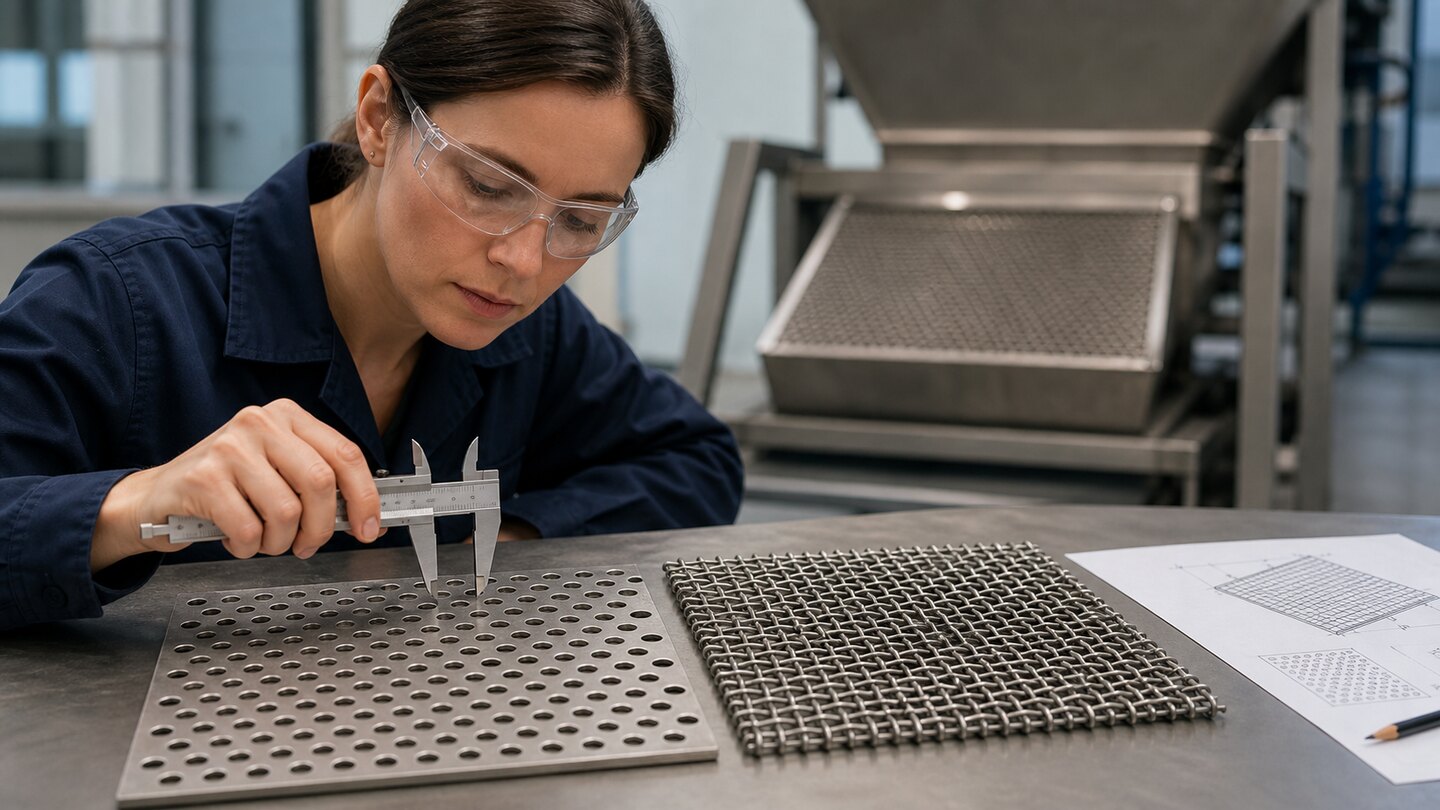
“5 mm opening” does not describe one interchangeable screen
A buyer is choosing a protective screen or product-separation layer for a process machine. One quotation says “5 mm woven wire mesh.” Another says “5 mm round-hole perforated plate.” Both sound as if the same object can pass through them. They are different constructions with different opening shapes, pitches, thicknesses, edge details, support behavior and request fields. A single hole-size number cannot make them like-for-like.
The first task is to state what the opening must do: let a product pass, retain an oversize piece, ventilate an enclosure, protect another component, distribute material or support a finished assembly. The second task is to describe the actual construction. This guide shows how to compare nominal geometry honestly, where the site’s free tools help and what needs to be specified before a supplier quotation becomes the default design.
Use the Woven Wire Mesh Calculator for a regular square-opening woven screen when mesh count and nominal wire diameter are known. Use the Open Area Calculator for orthogonal clear openings and projected wire diameters. Neither tool is a perforated-plate calculator, a flow model or a performance guarantee. A round-hole pattern uses a different geometric cell.
Start by identifying the construction branch
Woven wire mesh
Individual wires interlace. A regular square-opening cloth can be described by aperture, wire diameter, pitch and mesh count. Crimp, weave and finishing matter too.
Perforated plate
A sheet has holes punched or otherwise made in a defined shape and pattern. Hole diameter or square-hole width, centre distance, pattern, plate thickness and edge margins all matter.
Finished screen assembly
A frame, bends, seams, support bars, flange, fasteners and installation orientation can dominate the delivered part even when the screening surface is correctly described.
Other products
Expanded metal, welded mesh, slotted plate, wedge wire and perforated baskets need their own terminology. Do not relabel them as woven mesh or round perforated sheet.
The relevant standards are construction-specific. ISO 9044:2016 addresses industrial woven wire cloth with square apertures and expressly excludes pre-crimped and welded screens. ISO 10630:1994 specifies technical requirements and test methods for industrial perforated metal plate within the material, hole-size and thickness scope stated by ISO. A buyer should select the requirement that matches the proposed product, not cite a general word such as “mesh” after the design is already chosen.
How the geometry differs
For a regular square woven screen, clear aperture a and nominal wire diameter d determine an ideal pitch of a + d. The projected open-area ratio is the aperture fraction in one direction multiplied by the same fraction in the other direction:
pitch = clear aperture + wire diameter
open area (%) = (aperture ÷ pitch)² × 100
For equal round holes on a 60° staggered (triangular) centre pattern, a convenient projected-area expression uses the hole diameter D and centre-to-centre pitch P. The hole area is divided by the area of one repeating triangular cell:
open area (%) = [π ÷ (2 × √3)] × (D ÷ P)² × 100
≈ 90.69 × (D ÷ P)²
This second equation does not apply to straight-row round holes, square holes, slots, variable pitches, borders or a finished panel with a frame. It also does not predict discharge, airflow, pressure drop, product damage, cleanability or strength. It is simply a transparent way to compare the stated projected pattern geometry.
Worked comparison: two “5 mm” screens
Take a regular square woven mesh with 5.00 mm clear aperture and 0.80 mm nominal wire diameter. Its pitch is 5.80 mm, and its geometric open area is:
pitch = 5.00 + 0.80 = 5.80 mm
open area = (5.00 ÷ 5.80)² × 100 = 74.32%
The corresponding mesh count is 25.4 ÷ 5.80 = 4.38 openings per inch. Enter 4.38 openings/in and 0.80 mm wire in the Woven Wire Mesh Calculator to reproduce this nominal geometry. Its result is appropriate only because this example is regular square woven cloth.
Now take a perforated sheet with 5.00 mm round holes on 6.00 mm centres in a 60° staggered pattern. The geometric open area is:
open area = 90.69 × (5.00 ÷ 6.00)²
= 62.98%
Both examples contain a 5 mm nominal opening feature, but the calculated projected open area is different: 74.32% versus 62.98%. The shape is also different—a square woven opening versus a circular hole—and the perforated sheet has a stated plate thickness that becomes part of the passage path. Treating either number as a universal “5 mm screen” replacement hides useful purchasing information.
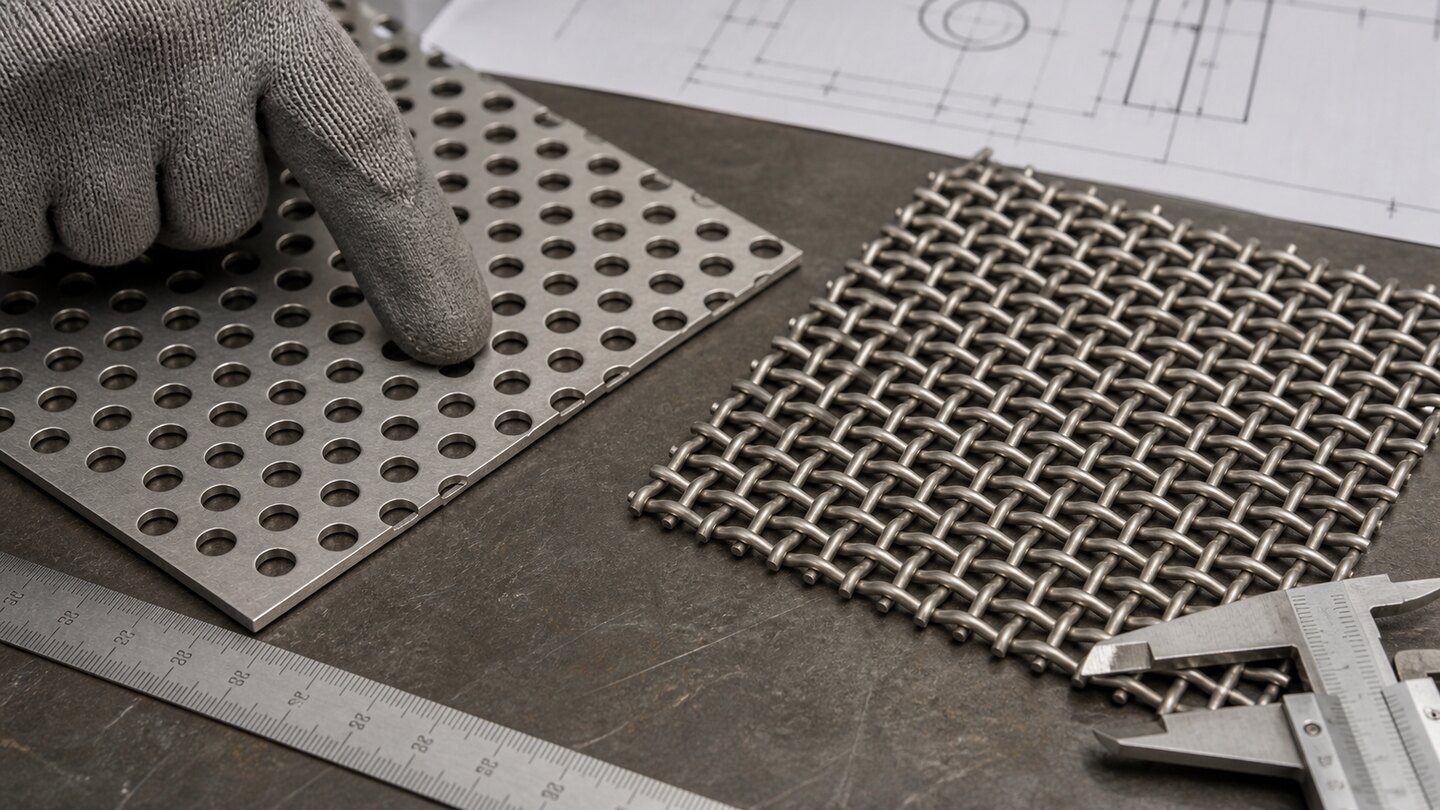
Do not use a woven-mesh calculator for round perforations
The Woven Wire Mesh Calculator uses pitch = 25.4 ÷ mesh count, then subtracts round-wire diameter to find a square clear aperture. The Open Area Calculator multiplies independent X/Y opening fractions. Both are useful, auditable models for their stated wire-grid inputs. Feeding a 5 mm round hole and a 6 mm centre distance into those tools would create a number for a different construction.
For a perforated plate, ask the supplier to state hole shape, nominal hole size, arrangement, centres, plate thickness, material, finish and border pattern. If projected open area is important, ask whether the supplier’s figure applies to the full sheet, the perforated field only, or the completed panel. Keep the calculation method with the drawing rather than carrying one percentage from a catalog image into a different hole pattern.
Compare the service question, not only the open area
Projected open area is one comparison input. It does not settle the material-selection or fabrication decision. A process can care about particle shape, near-size behavior, product orientation, bridging, wash-down, abrasion, corrosion, plate thickness, edge condition, support span, noise, cleanout access, frame geometry and available installation space. The required choice comes from the duty and an agreed way to validate the finished assembly.
For example, a round hole may be useful when a drawing requires a circular opening and a plate construction; a woven mesh may be useful when a regular mesh geometry and different available open-area relationship suit the duty. Those are not performance promises. Do not infer that either construction is universally stronger, cleaner, more open or better at separation from its name alone. State the requirement and have the responsible supplier or equipment owner confirm the proposed construction.
Thickness and edges belong in the RFQ
In woven mesh, wire diameter contributes to pitch, projected open area and nominal mass. In perforated plate, plate thickness is not the same dimension as the hole diameter; it affects the formed part, weight, edge condition and the physical path through the hole. A 5 mm round hole in 1 mm plate and the same nominal hole in a thicker plate are not identical finished surfaces. Do not ask a supplier to “match the mesh” when the old part was a plate with bends or a welded frame.
Measure the finished piece as well as its screening field. Record overall length and width, blank or non-perforated margins, bends, countersinks if present, cut-outs, mounting holes, support locations, flatness requirement, burr or edge requirement, material and finish. For corrosion or wash-down questions, use the Wire Mesh Material Selector to collect the temperature, chloride, chemical and cleaning facts before relying on a grade name.
Inspect samples without turning wear into a specification
- Keep the sample identified. Photograph both faces, the installed orientation, support, frame and part markings before cleaning, cutting or removing it from the record.
- Measure the right feature. For woven cloth, record clear aperture, wire diameter and construction. For plate, record hole shape and size, centres, pattern, thickness and margins.
- Use more than one location. Check a representative area and distinguish observed measurements from nominal drawing dimensions. Wear, deformation and burrs are not automatic evidence of original tolerance.
- Record the assembly. Note frames, welds, bends, rails, fasteners, gasket interfaces, backing layers and the direction of flow or product travel where relevant.
- Agree the next check. Use a drawing review, supplier sample or representative trial when the interface, separation result or service performance is important.
The sample-measurement guide helps organize basic evidence. For delivered goods, use the receiving-inspection checklist to connect the drawing, dimensions, documents and disposition.
RFQ wording that prevents a false comparison
Do not write only “5 mm mesh.” Use a drawing and identify the construction branch. The following is a starting format, not a substitute for engineering of the finished assembly:
Application, product/fluid and installation reference: [state];
construction: [regular square woven wire / round-hole perforated plate / other];
for woven: clear aperture [X] × [Y] mm, wire diameter [X] × [Y] mm, weave/crimp and material;
for perforated plate: hole shape and nominal size, pattern and centre distance, plate thickness, material and finish;
finished size, borders, bends, frame, supports, cut-outs, mounting and edge requirement: [attach drawing];
supplier to state tolerance, inspection basis, open-area basis if quoted, delivery form and assumptions;
acceptance plan: [drawing approval / sample / representative validation].
If the retained part is ambiguous, provide photos, caliper readings, the machine interface and the service duty through Request a Recommendation. Preserving uncertainty in the request is better than assuming a round perforation can be quoted as a woven mesh equivalent.
A practical decision path
- Describe the duty. Define what must pass or be retained, the process conditions, cleaning, service exposure and the finished-part interface.
- Identify construction. Separate woven wire, perforated plate and other screening media before using terms such as aperture or open area.
- Calculate only within scope. Use the woven or orthogonal-grid tools for their stated geometries. Use the correct pattern equation or supplier data for perforated plate.
- Compare complete proposals. Align hole/opening geometry, pitch, wire or plate thickness, material, finish, edge details, supports and document basis before comparing price.
- Validate the finished assembly. Inspect against the approved drawing and use a representative check when separation, flow or interface behavior materially affects the decision.
Frequently asked questions
Is 5 mm perforated plate equivalent to 5 mm woven mesh?
No. Hole shape, pitch, wire or plate thickness, open area, edge margins and finished assembly differ. State the construction and the full geometry before comparing suppliers.
Can I enter round-hole perforated plate into the Open Area Calculator?
No. That tool models orthogonal clear openings and wire diameters. A 60° staggered round-hole pattern uses a different repeating cell and calculation.
Does higher projected open area guarantee more flow?
No. It is a geometric ratio. Actual process behavior depends on the material, thickness, support, frame, pressure, product condition, fouling, installation and operating conditions.
Should a perforated-plate RFQ state plate thickness?
Yes. State thickness together with hole shape, size, pattern, centres, material, finish and finished-part details. Thickness is not implied by a hole diameter.
Can a sample prove the original specification?
A sample can provide valuable evidence, but wear, corrosion, distortion and modification may obscure original nominal values. Use the sample with drawings, records and a defined supplier review.