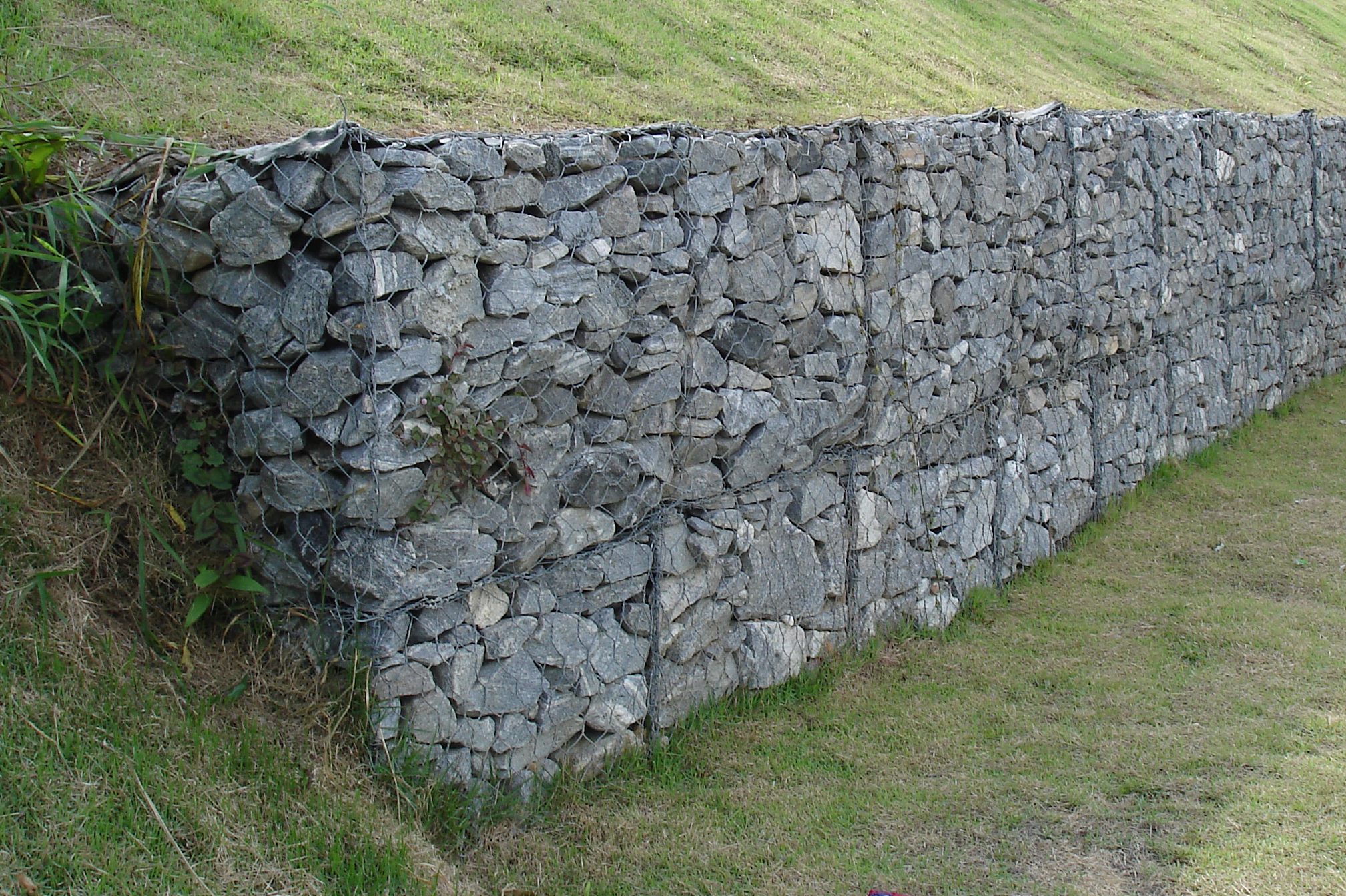
Featured photograph: Gabion1 by Eurico Zimbres, licensed CC BY-SA 2.5. The original image file is reproduced without alteration and scaled for display. This is a reference installation, not a Wire Mesh Selector customer project or a verified example of the specifications below.
A request for “gabion baskets, 50 × 100 mm mesh, galvanized” leaves several expensive questions unanswered. Does the mesh dimension mean the clear gap or the wire centre spacing? Is the basket welded or double-twisted? Are diaphragms, closing components and internal ties included? Has the proposed stone been checked against the actual basket system?
This guide helps purchasing teams turn those questions into a comparable RFQ. It includes a reproducible calculation using our free Open Area Calculator, but its purpose is specification checking, not structural design. Retaining walls, erosion-control structures and other load-bearing installations require project-specific engineering covering foundations, stability, drainage and the applicable approvals. A basket photograph, open-area percentage or supplier quotation cannot establish those requirements.
1. Specify the basket system before comparing mesh sizes
Welded rectangular mesh and double-twisted hexagonal mesh are different constructions. A nominal dimension from one cannot be substituted into the other without reviewing the drawing and the system requirements. In a welded panel, the repeated rectangular grid can be described with two pitches and two wire diameters. A hexagonal double-twisted mesh needs its own mesh designation and measurement convention; its twisted portions are not represented by a simple rectangular-grid formula.
ASTM A974-97(2021) covers welded wire fabric gabions and mattresses, including associated assembly wire components. Its published abstract includes weld and panel-joint strength requirements. ASTM A975-24 covers double-twisted hexagonal mesh gabions and revet mattresses and associated components. These are distinct product specifications, not interchangeable labels or complete retaining-wall designs.
State the applicable standard and edition only when the project requires it, and request supporting documents for the offered product. A statement such as “ASTM quality” does not identify the construction, edition, coating system or evidence being offered. If another regional standard governs the project, name that standard instead of assuming an ASTM designation is universally appropriate.
2. Resolve the 50 × 100 mm ambiguity with a drawing
For a hypothetical orthogonal welded panel with a 4 mm projected wire diameter in each direction, a 50 × 100 mm pitch gives clear openings of 46 × 96 mm. If 50 × 100 mm describes the clear openings instead, the pitches become 54 × 104 mm. Both descriptions sound similar in a short quotation, but they specify different grids.
| Hypothetical interpretation | Clear opening X × Y | Pitch X × Y | Projected open area |
|---|---|---|---|
| 50 × 100 mm means centre-to-centre pitch | 46 × 96 mm | 50 × 100 mm | 88.32% |
| 50 × 100 mm means clear opening | 50 × 100 mm | 54 × 104 mm | 89.03% |
The calculation is open area = aX / (aX + dX) × aY / (aY + dY) × 100, where a is clear opening and d is the projected wire width in the corresponding pitch. In the first row, 46 / 50 × 96 / 100 × 100 = 88.32%. In the second row, 50 / 54 × 100 / 104 × 100 = 89.03% after rounding. These are invented geometry examples, not recommended gabion specifications or standard acceptance values.
The percentage difference is not a reason to choose one basket. The important purchasing issue is that the opening, pitch, wire count across a panel and fit to the basket drawing may differ. Read our clear-opening versus pitch guide if a supplier uses “mesh size” without defining it.
Reproduce both cases in the tool
- Open the Open Area Calculator and select millimetres.
- For the pitch-defined example, enter clear opening X = 46, clear opening Y = 96, wire diameter in X pitch = 4 and wire diameter in Y pitch = 4.
- Confirm the result is 88.32%, with pitches of 50 and 100 mm.
- Change the clear openings to 50 and 100 while retaining both 4 mm wire values. The result becomes 89.03%, with pitches of 54 and 104 mm.
The tool describes an unobstructed orthogonal mesh projection. It does not calculate the permeability of a stone-filled basket, hydraulic discharge, stone retention, weld strength or wall stability. Do not enter an 80 × 100 hexagonal mesh designation as if it were a rectangular clear opening. Where a coating adds appreciable thickness, distinguish the steel-core diameter from the finished projected diameter before calculating or comparing measurements.
3. Select stone against the actual basket, not just a nominal number
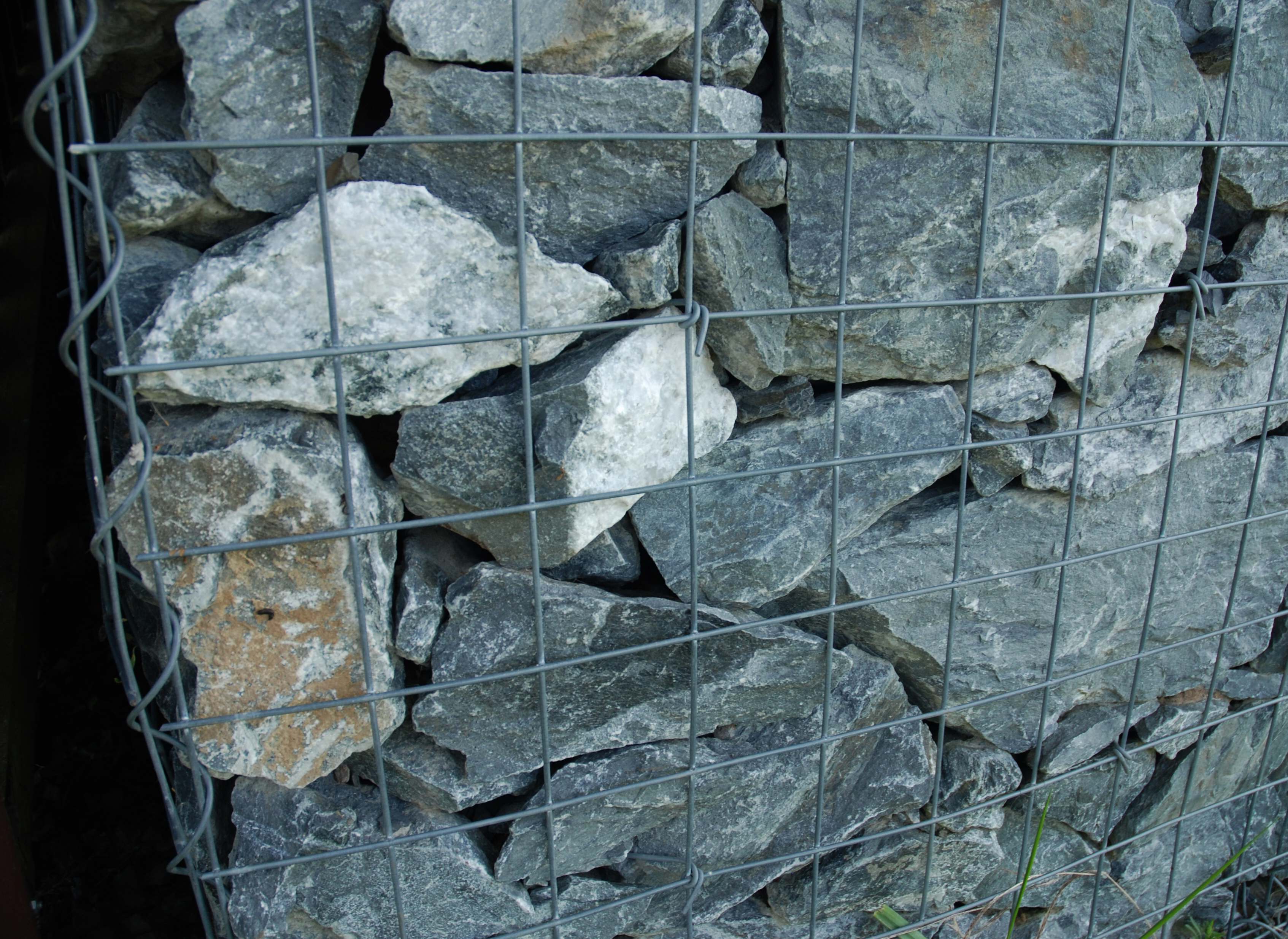
A rock-size label is not a complete description of individual stone shape. A flat or elongated piece may have a large longest dimension but a much smaller thickness. Its ability to remain behind the mesh depends on its three-dimensional shape, orientation and the actual openings. Conversely, a large piece that stays inside may still be difficult to place within a shallow compartment or around internal components.
Before ordering the full quantity, request the proposed stone grading and representative samples from the intended source. Ask the basket supplier and project designer to confirm the permitted grading and placement requirements for that system. Check the sample material against a representative assembled panel or basket under an agreed procedure. Record the amount of undersize material, elongated pieces and fines rather than selecting a few attractive stones for a photograph.
Do not adopt a universal rule such as “all stones must be 1.5 times the mesh size” without a governing specification. The appropriate requirements depend on the basket, application and approved design. Our geometry tool cannot validate a quarry grading or authorize smaller internal fill. If a proposed alternative changes the fill, lining or placement method, treat it as a substitution requiring review, not an automatic cost saving.
4. Compare complete assemblies, not panel-only prices
Two quotations for the same external basket dimensions may include different components. Require a drawing and bill of materials identifying each face, lid, base, internal diaphragm and the supplied joining and bracing items. Ask whether the delivery is flat-packed, partly assembled or fully assembled, and which components are fitted at the factory.
- Joining components: identify the proposed lacing, spiral binders, rings or other approved connectors, including quantities and required installation equipment.
- Internal components: identify diaphragms and ties or stiffeners by the approved drawing, not a generic “accessories included” statement.
- Wire and coating: specify the required material and coating for the mesh and each accessory; ask how component compatibility is documented.
- Panel and basket tolerances: distinguish unassembled panel dimensions from assembled external dimensions and agree the inspection condition.
- Documentation: request product identification, relevant test reports, coating evidence and the system assembly instructions.
Do not infer an outdoor service life from the word “galvanized.” Exposure, coating specification, fabrication details and damage all matter. Describe the intended environment in the RFQ and request a documented system proposal. The choice of connection spacing, bracing arrangement and repair method belongs to the approved system instructions and project requirements, not a generic web checklist.
5. Keep basket volume, stone mass and shipping mass separate
A hypothetical basket measuring 2.0 × 1.0 × 1.0 m has a nominal envelope volume of 2.0 m³. That does not mean it contains 2.0 m³ of solid rock with no voids. Do not multiply the envelope by a solid mineral density and present the answer as an accurate purchasing tonnage.
For illustration only, if the agreed placed bulk density were 1.65 t/m³, the arithmetic would be 2.0 × 1.65 = 3.30 t of fill. That density is an assumption, not a recommendation: replace it with evidence appropriate to the actual stone and placement method, and handle supplier grading losses or allowances separately. Stone delivery mass, empty basket mass and total shipping mass are different line items. A wire-mesh weight estimate does not include stone, connectors, pallets or every fabrication allowance.
6. A practical RFQ checklist
Use the following as a purchasing framework and attach the approved project drawings. Leave unresolved engineering requirements clearly marked for review rather than filling them with guessed defaults.
- Application, location and exposure; identify whether the order is for a retaining, hydraulic or decorative system.
- Required basket construction and applicable product standard with edition.
- Basket dimensions, quantities, diaphragm arrangement and drawing revision.
- Mesh dimensions with an explicit measurement convention, plus permitted tolerances.
- Steel-core and finished wire diameters where relevant, coating designation and required evidence.
- Complete connector and stiffener bill of materials, supplied quantities and assembly instructions.
- Approved stone requirements, sample approval responsibility and whether fill is included in the quotation.
- Inspection records, packaging, delivery format, spare components and any proposed deviations.
At receipt, reconcile package labels with the approved revision before assembly. Check representative dimensions and component quantities using the agreed sampling plan, record coating damage and segregate disputed items. Our wire-mesh receiving inspection checklist can help organize records, but the contract and approved system documents define acceptance.
Frequently asked questions
Can I replace a welded basket with a double-twisted one of the same size?
Not on dimensions alone. Treat this as a system substitution and obtain the required review of construction, connections, materials and design compatibility before purchasing.
Does higher open area mean better gabion drainage?
No. Bare-panel projected open area does not describe the stone-filled system or its interfaces with soil and filter materials. It is useful here only for checking the stated grid geometry.
Can a photograph confirm the wire diameter or stone grading?
No. Perspective and missing scale make photographs insufficient. Request dimensioned drawings, representative samples and the agreed inspection evidence; use photos to document context and visible condition.
What should I send for a specification recommendation?
Send the application, drawings, construction type, dimension definitions, coating requirements and the supplier data you need compared. Request a recommendation for help organizing the mesh specification. Structural and hydraulic approval remains with the qualified project designer.