Start with the separation objective, not a mesh number
A request such as “I need 250 micron mesh” sounds precise, but it leaves two different questions unanswered. Is 250 µm the characteristic dimension of a particle that should be retained, the largest particle allowed to pass, or simply a nominal opening copied from an old drawing? And is the process dry screening, liquid straining, hygienic product recovery or a protective screen? Those duties can begin with the same dimension and still require different constructions, materials and validation work.
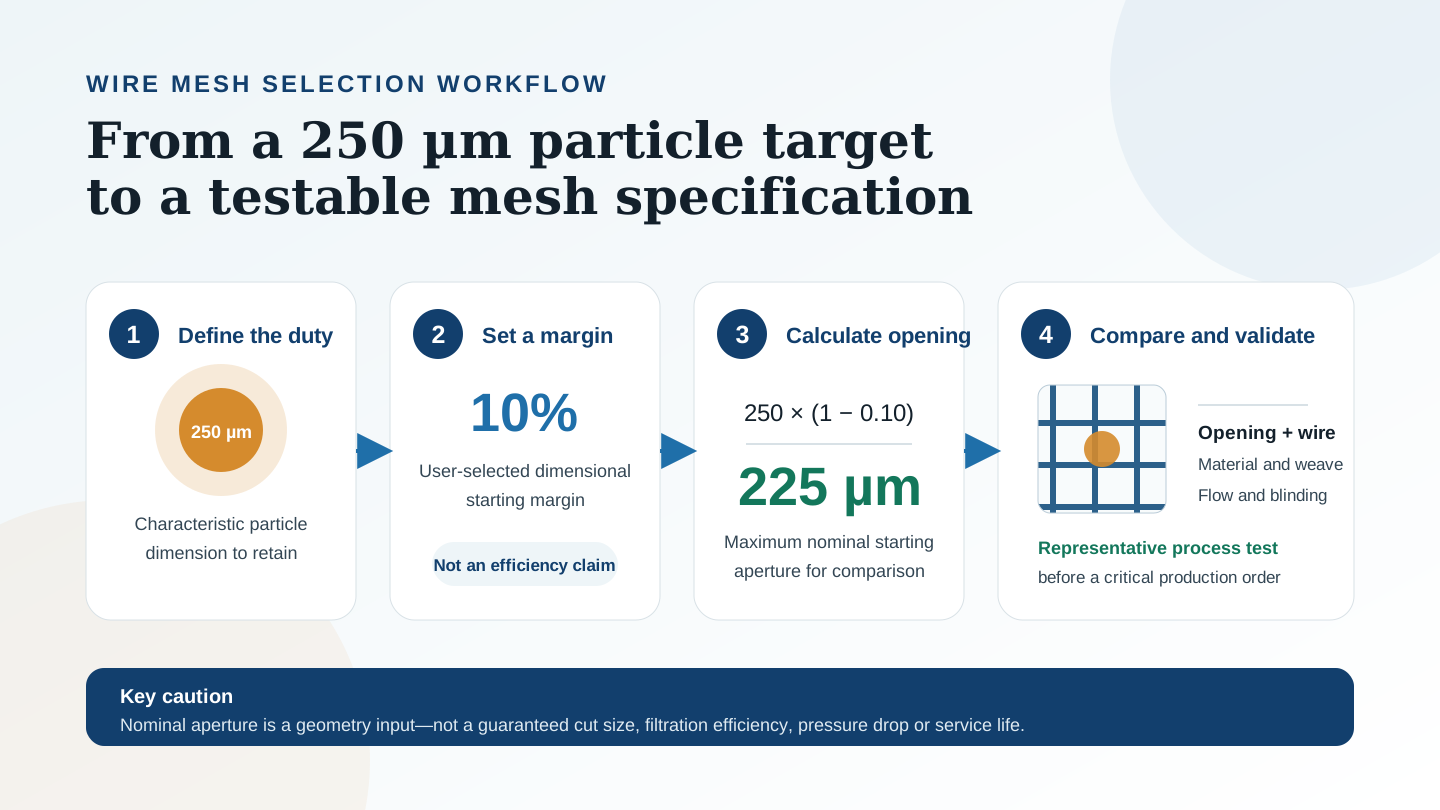
This worked example treats 250 µm as a characteristic particle dimension that the user wants to retain. It shows how the Filter Mesh Selector converts that target into a transparent dimensional starting point. It does not claim that one calculated opening guarantees a 250 µm cut. Real separation depends on the particle population and on the way the process presents those particles to the mesh.
Worked calculation: 250 µm with a 10% retention margin
Choose Retention starting point and enter a user-selected dimensional margin of 10%. The tool applies the margin directly to the characteristic particle dimension:
250 µm × (1 − 0.10) = 225 µm
225 µm = 0.225 mm
The result means “compare nominal apertures at or below 225 µm as a starting shortlist.” The 10% value is not a universal engineering factor and it is not hidden inside the calculator. It is a reviewable input that can be increased, reduced or removed when process evidence supports a different approach.
Why particle size and aperture are not the same thing
A mesh opening is a geometric dimension. A process stream contains particles with shape, orientation, surface condition and usually a distribution of sizes. A long thin particle can approach an opening end-first. A soft particle can deform. Agglomerates can break apart, while wet material can bridge several openings. Near-size particles can lodge in the cloth and progressively blind it. Vibration, feed depth, flow velocity and residence time change how often a particle has an opportunity to find an opening.
For liquid service, viscosity, differential pressure, support layers, solids loading and cake formation may dominate the result. For dry screening, vibration, inclination, impact, abrasion and bed depth matter. For food or hygienic equipment, cleanability, drainage, fabrication finish and applicable product-contact requirements are additional decisions. The calculator therefore returns a dimensional shortlist plus a validation focus instead of presenting a false “recommended mesh” certificate.
Convert the aperture into mesh-count and wire candidates
For nominal square-opening woven wire cloth, pitch equals 25.4 divided by mesh count per inch. Nominal aperture equals pitch minus nominal wire diameter. The same 225 µm boundary can therefore be approached by several mesh-count and wire-diameter combinations. Use the Reverse Mesh Specification Finder when the opening is known and you want to see the wire diameter required at each integer mesh count.
pitch = 25.4 ÷ mesh count
aperture = pitch − wire diameter
open area = (aperture ÷ pitch)² × 100
The following calculations are comparison examples, not stock declarations. They use nearby nominal combinations to show why mesh count alone is not enough:
| Illustrative combination | Calculated aperture | Calculated open area | Selection implication |
|---|---|---|---|
| 70 mesh/in + 0.14 mm wire | 222.86 µm | 37.72% | Heavier wire and lower projected open area. |
| 80 mesh/in + 0.10 mm wire | 217.50 µm | 46.93% | Intermediate geometry for sample comparison. |
| 100 mesh/in + 0.03 mm wire | 224.00 µm | 77.77% | Very fine wire; strength and weaveability need careful confirmation. |
All three nominal calculations fall at or below the 225 µm starting boundary, yet their wire section and projected open area differ greatly. A high-open-area result may look attractive for flow, but the required fine wire can be less robust, more sensitive to handling and unavailable in the exact calculated combination. A heavier wire may improve durability while reducing open area and increasing the tendency toward pressure loss or limited throughput. Ask the supplier to confirm preferred wire series, weaveability, tolerance and regular availability before a calculated combination is placed on a purchase order.
Opening-first specifications are easier to review
ISO 4783-2 describes preferred aperture and wire-diameter combinations for woven wire cloth and gives the designation sequence as aperture width, wire diameter, wire material and weave type. Its published scope covers apertures from 16 mm down to 0.02 mm. ISO 9044 defines terminology and technical requirements for industrial square-aperture woven wire cloth used for screening and describes permissible error and test methods. These scopes support an important purchasing habit: record the actual opening and wire information instead of relying on an isolated mesh number.
Check the current project requirements and obtain the relevant standard text before making a contractual reference. The official summaries are available from ISO 9044:2016 and ISO 4783-2:1989. The site’s calculation methodology explains which values here are formula-derived and why they are not certificates of delivered tolerance.
Choose material from exposure, not from particle size
The 250 µm target says nothing about corrosion, temperature or hygiene. For a dry, neutral indoor powder, carbon steel or stainless steel may both enter the initial review depending on contamination limits and expected life. Regular wash-down often shifts attention toward stainless construction and drainage. Chloride exposure requires concentration, temperature, pH, aeration and cleaning details; 316L may improve pitting resistance relative to 304, but it is not universally immune. An unidentified chemical environment should stop an automatic grade recommendation until compatibility information is available.
Also specify the fabricated condition. Cut edges, frames, welds, support screens and post-fabrication cleaning can determine whether a theoretically suitable alloy performs acceptably. For food equipment, assess the complete component, surface condition, cleanability, documentation and applicable regulation rather than treating a grade name as stand-alone approval.
Plan the validation around the real failure modes
Dry screening
Run representative feed at normal bed depth and motion. Record retained and passing fractions, throughput, blinding, wire wear and any particle damage.
Liquid straining
Measure clean and loaded pressure loss at operating flow. Observe cake formation, bypass risk, support-layer behaviour and the cleaning cycle.
Hygienic duty
Confirm retention together with cleanability, drainage, surface condition, traceability and the site’s applicable hygiene requirements.
Abrasive service
Inspect wire thinning, impact zones, edge fatigue and support contact. A marginally smaller opening is not useful if the cloth fails too quickly.
A useful trial compares more than one construction. Keep the same feed, flow and measurement method so the effect of aperture, wire and open area can be separated. Record the complete sample designation and supplier batch; otherwise a successful trial cannot be reproduced reliably in production.
What to send in a 250 µm filtration RFQ
- State whether 250 µm describes a particle to retain, a particle to pass or a required nominal opening.
- Provide the particle-size distribution, shape, hardness and whether particles deform, agglomerate or break.
- Describe dry or liquid service, flow or throughput, loading, allowable pressure loss and cleaning method.
- State the proposed nominal aperture, nominal wire diameter, mesh count when used, weave and required tolerance basis.
- Specify material grade, operating and cleaning temperature, chemicals, chloride exposure and contamination limits.
- Add roll, panel or fabricated-part dimensions, edge treatment, supports, quantity and destination.
- Define sample testing, inspection report, material certificate, labeling and production approval requirements.
Attach the calculator inputs and result to the RFQ so the supplier can see how the 225 µm starting boundary was created. If the process is critical, use the result to request samples and a test plan—not to skip validation.
Frequently asked questions
What mesh count is 250 micron?
There is no single answer because mesh count does not determine opening by itself. Wire diameter occupies part of each pitch. Specify or solve both mesh count and wire diameter, then calculate the nominal aperture.
Should a 250 µm particle use a 250 µm opening?
Not automatically. The answer depends on whether the objective is retention or passage, acceptable misplaced material, particle shape and the process. A visible dimensional margin can create a shortlist, but representative testing must establish performance.
Does a smaller opening always improve filtration?
A smaller opening may increase nominal retention, but it can also reduce throughput, increase pressure loss or blinding and change cleaning behaviour. Wire diameter, open area and support construction must be considered with the aperture.
Which tool should I use next?
Start with the Filter Mesh Selector for the retain/pass decision and service cautions. Use the Reverse Mesh Specification Finder to compare mesh-count and wire candidates, and the Mesh Micron Converter to verify any quoted combination. If the duty or available data remains uncertain, send the result for a specification review.