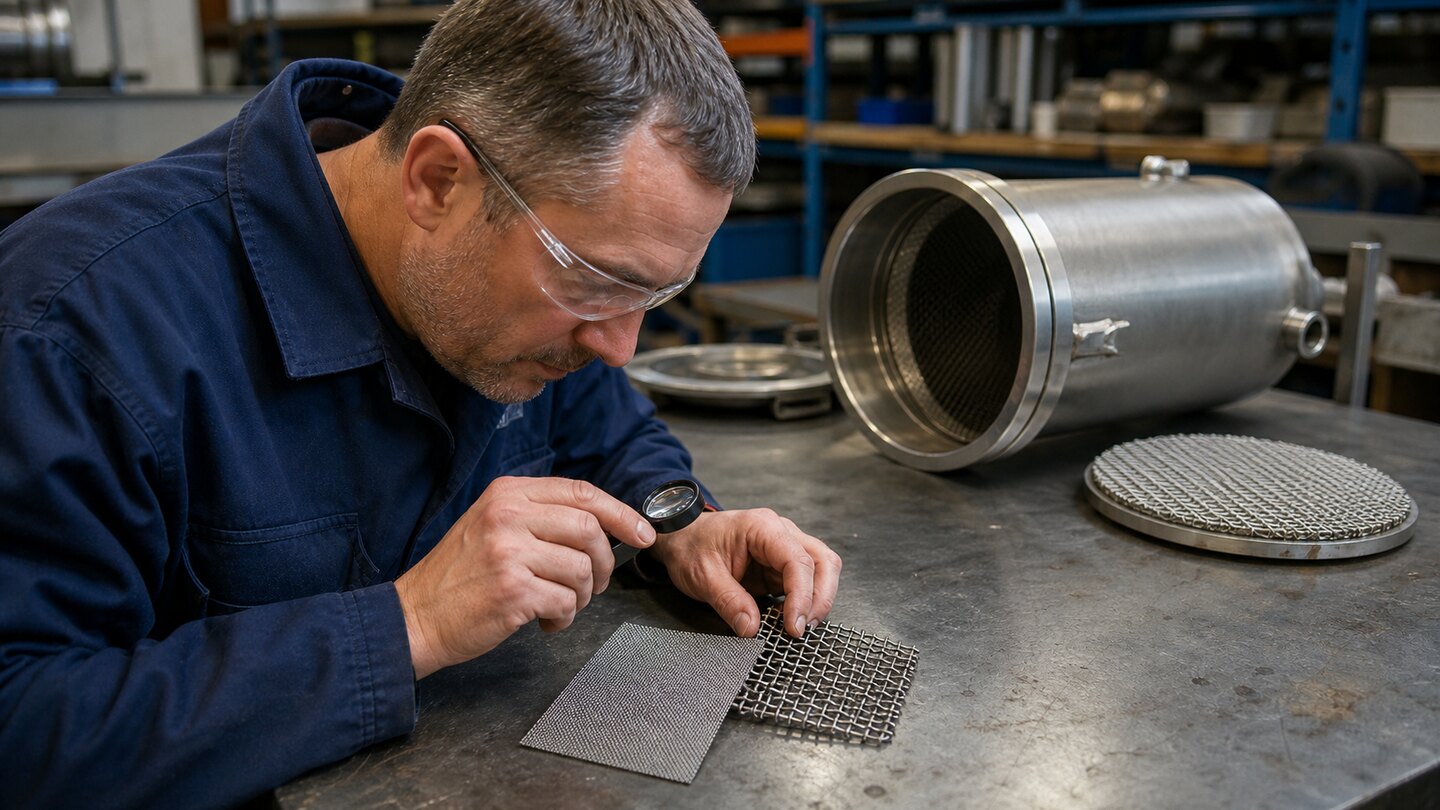
A “mesh count” answer can send a filter RFQ in the wrong direction
A process engineer needs a replacement wire-cloth element for a liquid strainer. The maintenance note says only “100 mesh stainless filter screen.” One supplier proposes a square-opening woven cloth. Another proposes Dutch weave with a micron retention statement. Both replies contain a mesh number, but they are not automatically interchangeable constructions.
For ordinary square-opening woven wire cloth, mesh count, nominal wire diameter and pitch can be used to calculate a nominal clear opening and geometric open area. For Dutch weave filter cloth, the visual structure, wire relationship and filtration description are different. A Dutch-weave mesh number is not a simple square opening, and it should not be entered into a square-opening calculator as if it were one.
This guide explains the practical difference, identifies the questions a buyer should ask before comparing quotes, and shows where the site’s Filter Mesh Selector helps—and where its square-opening geometry does not apply. The goal is not to choose a winner from a label. It is to build a specification that a supplier can state, test and trace.
Start by identifying the construction
Square-opening woven cloth
Regular openings repeat in both principal directions. With mesh count and wire diameter, nominal pitch, opening and geometric open area can be calculated.
Dutch weave filter cloth
A dense filtration construction with different wire arrangements in its principal directions. It does not present the same simple square clear opening used by standard mesh-count geometry.
Welded or pre-crimped screen
These are distinct products with construction-specific terminology, tolerances and service considerations. Do not relabel them as woven filter cloth.
Finished element
A basket, disc, leaf, pleated element or supported laminate adds seams, supports, edge treatment and assembly details beyond the cloth itself.
ASTM E2814-22 describes industrial woven wire filter cloth as a special filtration grade, also known as Dutch or Hollander weave. Its official summary notes that the construction uses a greater number of wires in one direction than the other and two different wire diameters, and that acceptance criteria can be based on desired pore size or a micron retention filtration rating. That is a different purchasing language from a simple square aperture.
Do not infer construction from a sales phrase such as “fine mesh.” Ask for the weave designation, both wire directions, material, nominal thickness where relevant, the supplier’s stated filtration metric, the test or inspection basis, and the proposed finished element construction. Preserve an old sample before cleaning or cutting it; the sample measurement guide helps record visible geometry and evidence, but it cannot turn a Dutch weave into a simple square-aperture calculation.
Why square-mesh arithmetic cannot be copied to Dutch weave
For a regular square-opening cloth, the geometry is transparent. One inch equals 25.4 mm. If n is the mesh count and d is the nominal wire diameter, the ideal pitch is 25.4 divided by n, and the ideal opening is that pitch minus d. The Woven Wire Mesh Calculator shows this relationship clearly.
pitch (mm) = 25.4 ÷ mesh count
nominal opening (mm) = pitch − wire diameter
geometric open area (%) = (opening ÷ pitch)² × 100
Those equations assume a repeating square opening bounded by equivalent wire spacing in both directions. A Dutch weave has a denser, directional construction and does not offer that same visible square opening. Reporting “open area” from the square formula for a Dutch weave can therefore create a number with false precision. Likewise, a 100-mesh label on a square cloth is not a conversion key for a 100-mesh Dutch weave.
The distinction matters commercially. A purchase team might compare the price of a square cloth with the price of a Dutch filter cloth and believe that only the mesh number changed. In reality, the material quantity, weave, thickness, pressure-loss behaviour, cleaning response, support need and filtration evidence may all be different. None of these properties should be inferred from mesh count alone.
A useful tool result: a starting boundary, not a Dutch-weave selection
Suppose a liquid process needs to retain particles described by the engineering team as 100 µm. In the Filter Mesh Selector, choose retain, enter 100 µm and make the dimensional margin explicit. With a 10% selected margin, the tool produces a 90 µm maximum starting aperture for its square-opening candidate search:
starting aperture = characteristic particle dimension × (1 − selected margin)
90 µm = 100 µm × (1 − 10%)
This is deliberately a starting boundary, not a promise that 90 µm square mesh will retain every 100 µm particle, nor a statement that a Dutch weave should be ordered at “90 micron.” Particle shape, size distribution, orientation, deformation, agglomeration, loading, fluid viscosity, flow, fouling and supporting hardware affect real separation. The selector itself makes these limitations explicit and directs a representative validation.
Use the result in two different ways:
- For a square-opening short list: use the tool’s candidate table, then enter each actual supplier mesh count and wire diameter into the Woven Wire Mesh Calculator. Confirm the calculated nominal opening, open area and material reference before comparing prices.
- For a Dutch-weave inquiry: state the process particle information and the 90 µm dimensional starting point as project context, then ask the supplier to recommend a filter-cloth construction and provide its own stated filtration metric, test basis and limitations. Do not use the square candidate table as a Dutch-weave conversion table.
What to ask a Dutch-weave supplier to state
The word “micron” needs context. It may describe a nominal pore model, a filtration rating, a test result, an application recommendation or a marketing range. Ask the supplier to state exactly what the number represents and how it relates to the supplied material.
| Question | Why it prevents a bad comparison | Evidence to request |
|---|---|---|
| What is the exact weave designation and orientation? | “Dutch weave” is not one geometry; construction must be identified before it can be reproduced. | Supplier data sheet, drawing or approved sample reference |
| What do the stated micron and retention values mean? | A pore description, a calculated value and a tested retention result are not the same claim. | Defined test method, fluid/conditions, acceptance criterion and report scope |
| What material and wire condition are proposed? | Material grade, annealed/hard condition and fabrication affect suitability and repeatability. | Material requirement, certificate scope and lot traceability where ordered |
| What finished-element support is included? | Backing layers, seams, edge treatment and pressure direction can control element behaviour. | Assembly drawing, support construction and installation orientation |
| How will the element be cleaned and re-used? | Cleaning chemistry, reverse flow, handling and contamination risk can affect service and verification. | Application-specific cleaning guidance and validation plan |
Ask comparable questions of every bidder. “Supplier A says 5 µm; Supplier B says 200 mesh” is not a like-for-like comparison until the construction, rating definition, material, test basis and finished element are known. The wire mesh quotation comparison guide offers a neutral way to organize these fields.
Inspect a sample without misidentifying it
A retained filter disc or offcut is useful evidence, especially when the original purchasing record is incomplete. It cannot by itself establish a complete filtration rating after months of service, fouling, cleaning or damage. First document where it was used, flow direction, support arrangement, process fluid, operating temperature, cleaning method and failure mode.
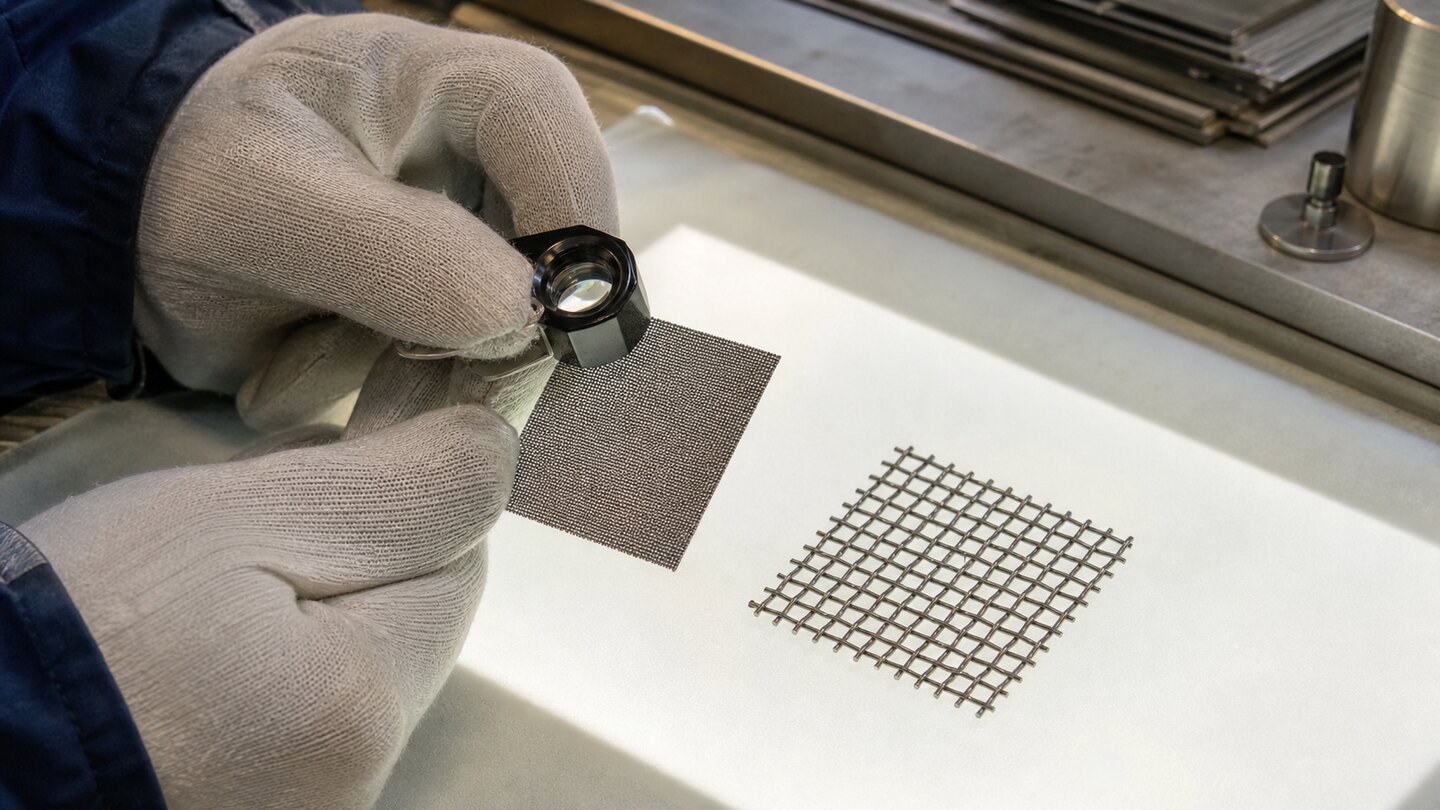
- Keep the sample identified. Photograph both sides, edge details, frame or support, and any marking before cleaning or cutting.
- Look for directional structure. A dense, asymmetric visual weave is a reason to stop using square-opening geometry and ask for filter-cloth documentation.
- Separate cloth from element. Record backing mesh, perforated support, pleat form, welds, glue, frames and seals. The same cloth can behave differently in different assemblies.
- Do not over-read a caliper or loupe. These can support a construction observation. They do not establish a pore-size distribution, a micron retention rating or process suitability.
- Request a representative comparison. When performance is critical, compare proposed samples in the actual or representative fluid, pressure, flow and cleaning conditions under an agreed plan.
Standards identify scope; the purchase order identifies acceptance
ASTM E2814-22 is relevant to industrial woven wire filter cloth for filtration and recognizes alternative acceptance criteria based on pore size or micron retention. It does not remove the need to define the specific construction, material, finished form, test conditions and acceptance requirement for a particular process. A current standard must be purchased and applied in its full contractual context.
For square-aperture industrial woven cloth, ISO 9044:2016 specifies technical requirements and test methods within the scope stated by ISO. Its official abstract also makes clear that square-aperture cloth, pre-crimped screens and welded screens are not one interchangeable category. Select the standard that actually fits the supplied construction; do not cite a standard merely because it contains the word “mesh.”
RFQ wording that does not confuse constructions
Do not write “100 mesh Dutch weave, 100 micron” unless those terms are defined by the selected supplier construction and your acceptance documents. A clearer request gives the supplier the duty and asks it to state the construction and evidence:
Stainless woven wire filter cloth for [fluid and process];
target retained particle information: [state size, distribution and objective];
process conditions: [temperature, flow, pressure/differential pressure, chemistry, solids loading];
required finished form: [disc, basket, leaf, panel or other]; flow direction and support: [state];
supplier to propose Dutch-weave designation, material, wire directions, thickness and stated micron/pore/retention metric;
supplier to state the test or model basis, acceptance criterion, document scope, cleaning limits and traceability offered;
purchaser and supplier to agree representative sample or performance validation where required.
When material exposure is uncertain, use the Wire Mesh Material Selector to structure the temperature, wash-down, chloride and chemical questions before relying on a grade label. If the purchase team has a used sample and incomplete data, submit the photographs, measurements and process duty through Request a Recommendation before the quotation becomes the de facto specification.
A repeatable selection path
- Describe the separation problem. State particle information, fluid, objective, operating conditions, pressure/differential pressure, flow, solids loading, cleaning and allowable changeout constraints.
- Use the Filter Mesh Selector honestly. Choose an explicit dimensional margin and treat its result as a square-opening starting point, not a universal filter rating.
- Choose the right construction branch. Continue with square-opening calculations only for regular square cloth. Create a separate Dutch-weave supplier inquiry for filter-cloth solutions.
- Compare evidence rather than labels. Align material, weave, stated metric, test basis, finished element, support, delivery form and acceptance requirement before comparing cost.
- Validate representative performance. Use an agreed sample or trial whenever separation, pressure loss, cleanability or service life is material to the decision.
Frequently asked questions
Can I convert Dutch weave mesh count directly to micron?
No. Dutch weave does not use the same simple square clear-opening relationship as ordinary square woven cloth. Ask the supplier to define the proposed filter-cloth construction and the meaning and basis of its stated micron or retention value.
Does a lower micron number always mean better filtration?
Not automatically. The required result depends on what must be retained or passed, the particle distribution, fluid conditions, flow, pressure loss, fouling, cleaning and the agreed performance evidence.
Can the Filter Mesh Selector choose a Dutch weave?
No. It creates a dimensional starting point and regular square-opening candidates. Use it to articulate the separation problem, then request a Dutch-weave proposal with supplier-defined filtration evidence.
Can a square-mesh open-area calculation predict Dutch-weave flow?
No. The square formula does not model Dutch-weave geometry, thickness, pore path, support layers, fluid properties or fouling. Do not turn the result into a flow or pressure-loss guarantee.
What should I keep from an old filter element?
Keep photos, flow direction, support details, service conditions, cleaning history, dimensions, markings and an identified sample if the site permits. These facts help a supplier evaluate a proposal, but they do not replace a defined acceptance method.