Mesh count is not a micron rating
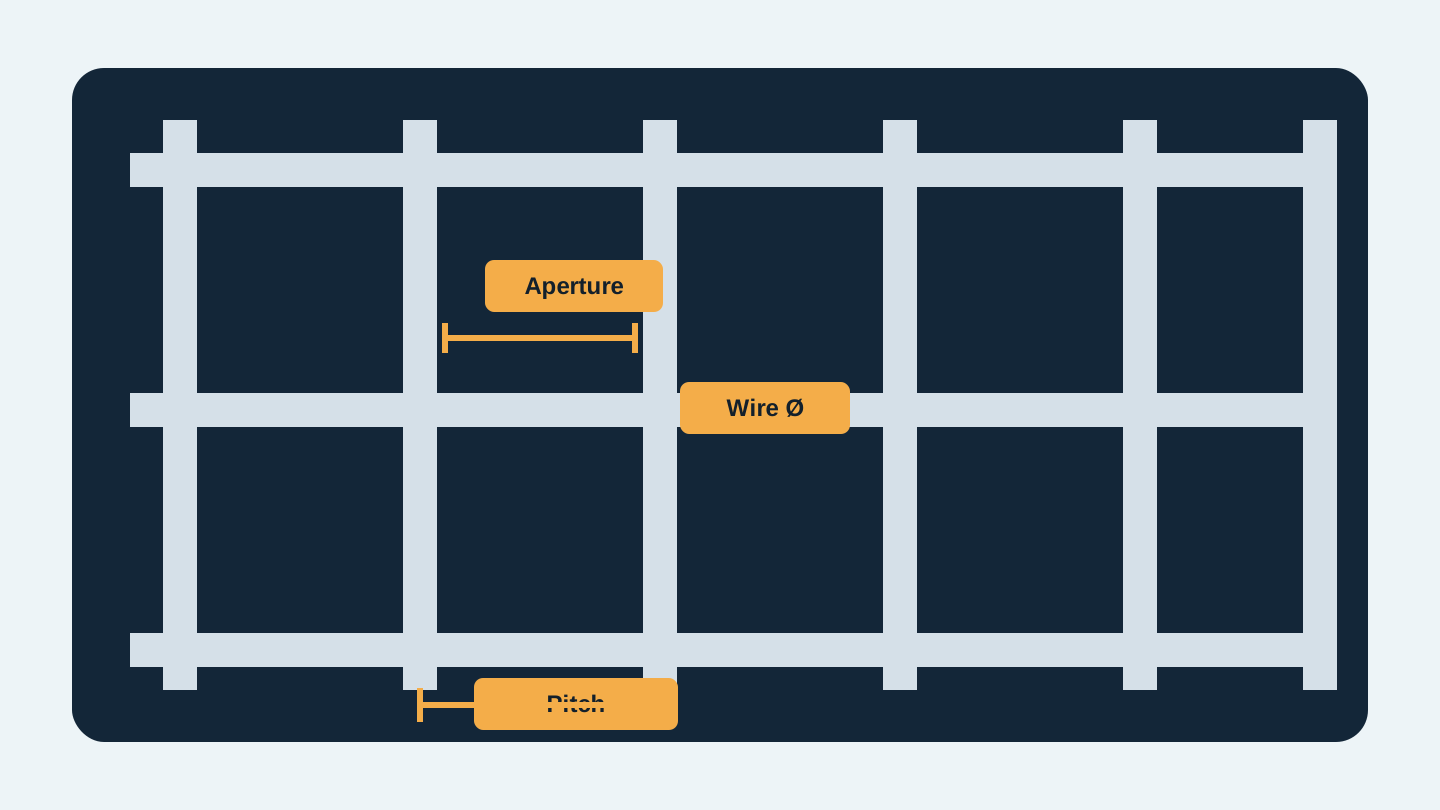
A request for “100 mesh” is incomplete because mesh count states only how many openings occur in one linear inch. The wire occupies part of that inch, so the clear opening depends on nominal wire diameter. A 100-mesh cloth made with a finer wire has a larger opening and more open area than a 100-mesh cloth made with a heavier wire. This is why two conversion charts can show different micron figures without either chart necessarily making an arithmetic error.
The three geometry equations
For nominal square-opening woven cloth measured in openings per inch, pitch equals 25.4 divided by mesh count. Clear aperture equals pitch minus nominal wire diameter. Geometric open area equals aperture divided by pitch, squared, then multiplied by 100. Keep every length in the same unit before applying the formulas.
pitch = 25.4 ÷ mesh count
aperture = pitch − wire diameter
open area = (aperture ÷ pitch)² × 100
Worked example: 10 mesh with 0.56 mm wire
The nominal pitch is 25.4 ÷ 10 = 2.54 mm. Subtracting 0.56 mm wire gives a nominal clear aperture of 1.98 mm, or 1,980 micrometres. The geometric open area is (1.98 ÷ 2.54)² × 100, approximately 60.8%. These figures describe nominal geometry; they do not state the delivered aperture tolerance, wire tolerance, flatness or edge condition.
How to measure an existing sample
Count openings over a distance long enough to reduce counting error, and measure in both principal directions. Use a suitable micrometer for wire diameter and take several readings away from damaged edges. Woven wires are crimped, so careless measurement at a crossover can distort the result. Compare the measured clear opening with the calculated relationship, but do not force a worn, stretched or coated sample into a nominal specification.
What changes outside square woven cloth
Rectangular mesh needs separate X and Y openings and wire dimensions. Dutch-weave filter cloth does not have a simple square clear aperture that can be inferred from mesh count alone. Welded mesh is normally described using clear opening or center-to-center pitch plus wire diameter, not the same woven-cloth convention. A test sieve also has tolerance and inspection requirements beyond a nominal industrial screen.
Fields to put on an RFQ
- Weave or construction type.
- Nominal aperture and nominal wire diameter, with units.
- Mesh count per inch when it is part of the agreed designation.
- Material grade, roll or panel size, edge condition and quantity.
- Applicable tolerance or standard, inspection report and certificate requirements.
When one value is unknown, use the converter to solve the nominal relationship. Treat the answer as a calculation, then ask the supplier to confirm whether the combination is manufacturable and regularly available.
Nominal geometry versus delivered tolerance
The equations use nominal values, while real industrial wire cloth has permitted variation in aperture, wire diameter and count. The applicable tolerance system depends on the product and purchase agreement. ISO 9044 covers technical requirements and tests for industrial woven wire cloth with square apertures; ASTM E2016 is another purchasing reference for industrial woven wire cloth. Neither should be cited by number alone without confirming its current edition and scope. Dutch weave, welded cloth and test sieves require different treatment.
A quick plausibility check
Pitch must always be larger than wire diameter and clear aperture must be positive. Open area must fall between zero and 100%. Recalculate in one unit system and compare several openings rather than trusting one damaged location. If a chart, sample label and measurement disagree, keep all three records and ask which value controls the order.