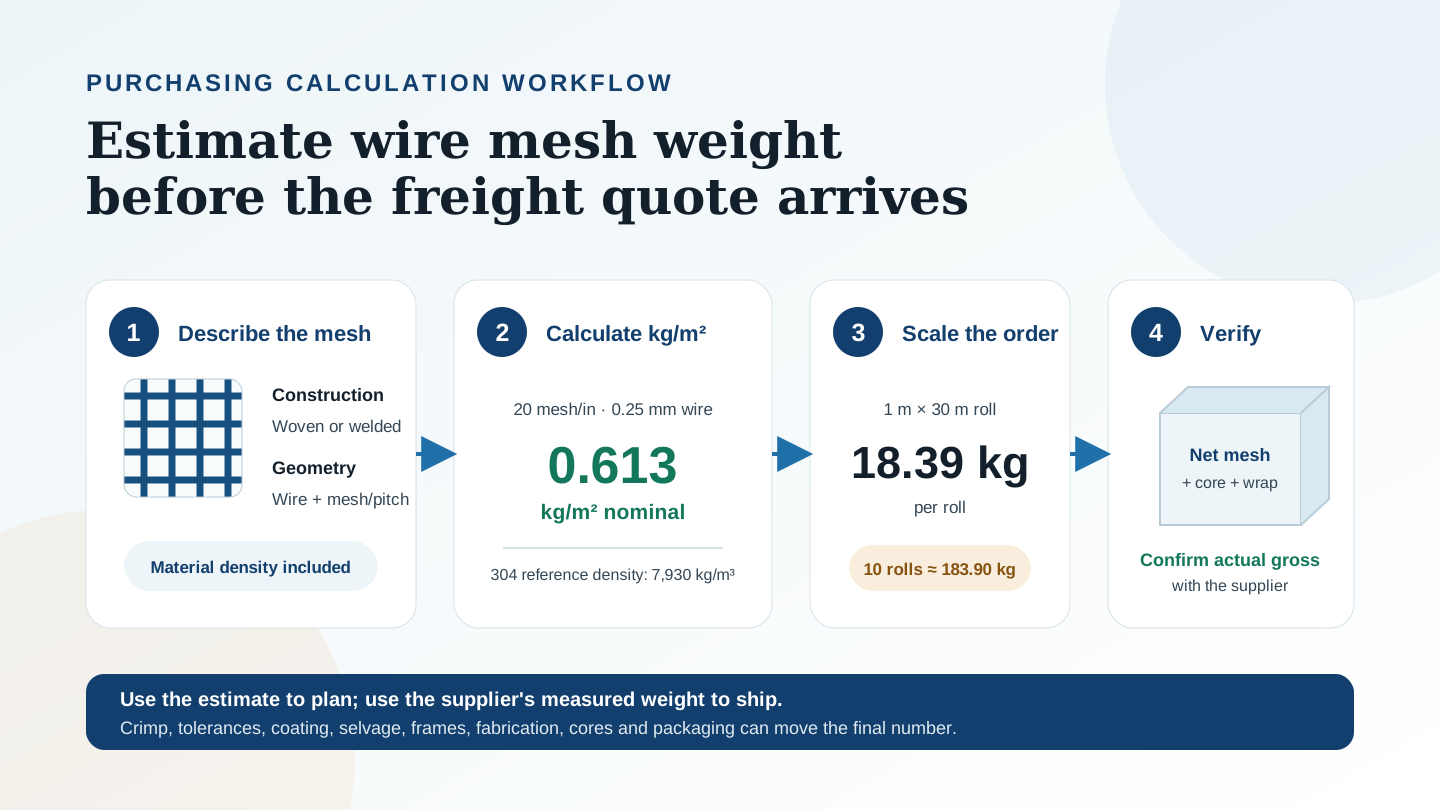
Why estimate wire mesh weight before requesting a quote?
Wire mesh is often purchased by roll, panel or fabricated piece, while freight forwarders, warehouse teams and lifting plans work in kilograms. That mismatch creates avoidable delays. A buyer may know “20 mesh, 0.25 mm wire, one metre wide” but still be unable to estimate whether ten rolls belong in a parcel shipment, on a pallet or in a dedicated freight movement. An early weight calculation gives purchasing a defensible planning number before the supplier confirms the manufactured and packed weight.
The Wire Mesh Weight Calculator estimates nominal net mesh mass from construction, wire geometry, material density, finished dimensions and quantity. It supports square-opening woven cloth and rectangular welded grids. The result is useful for comparing quotations, checking an order-of-magnitude freight figure, planning handling and finding obvious specification errors. It is not a scale ticket, a certified mass or a shipping gross weight.
The calculation starts with the construction
Woven and welded mesh cannot share one spacing input. For square-opening woven cloth, mesh count states the number of openings per linear inch and the pitch is 25.4 divided by that count. The calculator models wire running in two perpendicular directions and uses the cross-sectional area of nominal round wire. For welded mesh, the input is the centre-to-centre pitch in each direction—not the clear opening between wires.
wire area = π × wire diameter² ÷ 4
woven mass/m² = 2 ÷ pitch(m) × wire area(m²) × density
welded mass/m² = [1000 ÷ pitch X(mm) + 1000 ÷ pitch Y(mm)] × wire area(m²) × density
piece mass = mass/m² × finished width × finished length
These formulas are transparent length-times-area-times-density calculations. They assume the wire dimensions and spacing entered are nominal and regular. If a supplier describes only a clear opening, first use the Woven Wire Mesh Calculator for woven cloth or confirm the centre pitch on a welded-grid drawing. Substituting clear opening for pitch will overstate the amount of welded wire.
Worked example: a 20 mesh stainless steel roll
Consider plain square-opening woven cloth specified as 20 openings per inch, 0.25 mm nominal wire, stainless steel 304, 1 m finished width and 30 m finished length. The calculator uses a 304 reference density of 7,930 kg/m³. The pitch is 25.4 ÷ 20 = 1.27 mm, leaving a calculated nominal aperture of 1.02 mm. Entering the geometry in the weight tool produces:
| Output | Calculated value | How purchasing can use it |
|---|---|---|
| Nominal mass per area | 0.613 kg/m² | Compare the same construction across widths and lengths. |
| Area per roll | 30.000 m² | Check that width and roll length were interpreted correctly. |
| Nominal mass per roll | 18.39 kg | Make an early manual-handling and packaging assessment. |
| Nominal mass for 10 rolls | 183.90 kg | Create a provisional freight request before packed data is available. |
The arithmetic is reproducible: 0.6130125 kg/m² × 1 m × 30 m = 18.3904 kg per roll, and ten rolls give 183.9038 kg nominal net mass. The tool rounds the displayed values but keeps full precision inside the calculation. A freight booking should still use the supplier's final packing list, not 183.90 kg.
Wire diameter usually drives more change than buyers expect
At unchanged mesh count and material, calculated mass varies with the square of wire diameter. Increasing diameter from 0.20 to 0.30 mm is a 50% increase in diameter but a 125% increase in nominal mass. It also reduces aperture and projected open area. That is why a quotation that says only “20 mesh stainless” is not complete enough for a weight or performance comparison.
| 20 mesh, stainless 304 | Calculated aperture | Calculated open area | Nominal kg/m² | 1 × 30 m roll |
|---|---|---|---|---|
| 0.20 mm wire | 1.070 mm | 70.99% | 0.392 | 11.77 kg |
| 0.25 mm wire | 1.020 mm | 64.50% | 0.613 | 18.39 kg |
| 0.30 mm wire | 0.970 mm | 58.33% | 0.883 | 26.48 kg |
Use the Open Area Calculator alongside the weight estimate. Lower mass is not automatically better: a finer wire may be unsuitable for mechanical loads, abrasion, edge tension, unsupported spans or cleaning. Higher mass is not automatically stronger either, because alloy condition, weave, support, fabrication and load direction still matter.
Worked example: welded panels
Now consider mild-steel welded mesh with 25 × 25 mm centre-to-centre pitch, 2.0 mm round wire, and panels measuring 1 × 2 m. Using the tool's steel density of 7,850 kg/m³ gives 1.973 kg/m², 3.95 kg per panel and 197.29 kg for 50 panels. The calculation counts 40 metres of longitudinal wire and 40 metres of transverse wire per square metre before applying circular wire area and density.
This example does not include zinc coating, trimmed-edge details, projecting wires, frames, hooks or welded attachments. If the product is galvanized, the calculator deliberately describes its galvanized option as a steel-density estimate with coating excluded. Request the specified coating mass or the supplier's measured product weight when the difference matters.
Material density is a reference value, not an alloy certificate
The calculator displays the density used with every result: 7,930 kg/m³ for stainless 304, 7,980 for stainless 316L, 7,850 for carbon or galvanized steel before coating, 2,700 for aluminium and 8,960 for copper. These are practical nominal reference values. Actual density varies slightly with grade chemistry and product condition. As a cross-check, an official Outokumpu environmental product declaration reports 7,900 kg/m³ at 20°C for an austenitic grade group including 304 and 316L. The small difference illustrates why an early estimate should not be presented as measured shipment mass.
Use the supplier's confirmed alloy and product data when the procurement tolerance is tight. The Outokumpu austenitic stainless steel declaration is a useful primary-source density cross-check, but it does not certify wire supplied by another producer.
What the nominal model leaves out
Weave crimp
Woven wires travel over and under one another, so their real path is longer than a perfectly straight projected line. The effect depends on weave and geometry.
Manufacturing tolerances
Delivered wire diameter, aperture, roll width and length have permissible variation. Small wire-diameter changes have a squared effect on mass.
Edges and fabrication
Selvage, trimmed edges, seams, frames, hooks, backing screens, overlaps, weld metal and cut-outs change finished-part mass.
Coating and packaging
Galvanizing, polymer coating, oil, cores, spools, pallets, cases and moisture protection are outside the nominal mesh calculation.
ISO 9044 defines terms, maximum permissible error, requirements and test methods for industrial square-aperture woven wire cloth within its scope. ASTM E2016 likewise covers industrial woven wire cloth for general use and establishes terms, normal specification ranges, tolerances and requirements; its scope excludes welded wire cloth. These official scopes are a reminder that nominal dimensions need a tolerance and inspection basis when mass or aperture is commercially important. Review the current ISO 9044:2016 summary, the ASTM E2016-22 page and the project's calculation methodology before placing a contractual standard reference.
Turn the result into a better freight and handling request
- Record construction, material, nominal wire diameter and mesh count or X/Y centre pitch exactly as entered.
- State finished width, finished length, number of rolls or panels and whether dimensions include projecting edges.
- Give the calculator's nominal net mass as an estimate, with the calculation date and assumptions.
- Ask the supplier for measured or declared net weight, gross packed weight, number of packages and dimensions of each package.
- Confirm core, pallet or case construction, stacking restrictions, lifting points and protection from moisture or deformation.
- For manual handling, follow the destination's risk assessment and lifting rules; do not infer safe handling from mass alone.
- For container planning, check both mass and cubic space. Mesh rolls can reach a volume limit before a payload limit.
A large difference between the calculated and quoted net weights is not automatically proof of an error, but it is a reason to reconcile the specification. Check whether the supplier used a different wire diameter, roll length, width, density, weave allowance, coating or fabricated edge. This makes the weight tool especially useful with the Wire Mesh Quotation Comparison Guide.
Frequently asked questions
Can I calculate roll weight from mesh count alone?
No. A woven-mesh estimate also needs nominal wire diameter, material density, roll width and roll length. Mesh count alone does not determine aperture, open area or mass.
Is calculated mesh weight the same as shipping weight?
No. The calculator estimates nominal net mesh mass. Shipping gross weight includes packaging and may include cores, frames, coatings or fabrication not represented by the model. Use the final supplier packing list for booking.
Should I add a standard percentage for woven-wire crimp?
There is no universal percentage suitable for every weave, mesh and wire combination. Use the straight-wire result as a transparent planning baseline, then obtain an actual sample, production or supplier weight when a tighter number is required.
Why does a small wire-diameter change affect mass so much?
Round-wire cross-sectional area is proportional to diameter squared. At the same spacing and density, a 10% increase in diameter produces about a 21% increase in calculated wire mass before other manufacturing effects.
What should I do with the calculator result?
Save the geometry and result with the RFQ, compare it with supplier quotations, and ask for both net and packed weights. If the construction or exclusions are uncertain, request a specification review and include the intended application, dimensions and destination.